
On Being Home, Awake

One of the biggest life lessons I keep coming back to from all of my travels is that life hits you in the face when you least expect it, and it hits you in a very big, very real way. Life is uncomfortable. Travelling is uncomfortable. It’s new and different. It can be very strange.

People have always been afraid of what is different. I don’t know why. Perhaps it’s a “chicken and egg” conversation: which came first, the fear or the stereotypes?

I’m living in Memphis now. But I’m not living in the same Memphis I grew up in, and sometimes, I feel really ashamed that I never knew my current Memphis when I was young. My Memphis is Black; 60 percent African American to be precise. But that’s not the Memphis I knew growing up, which evidences the other reality of my current Memphis. My Memphis is segregated as hell.

Why didn’t I see it before? On some level I think I knew, but I never thought deeply about it, nor cared enough to do so. My school was white, my family was white, we were all middle class, we were all the same. So what did I have to be afraid of?

Injustice hit me like a brick to the face the first time I saw the terrible cement wall separating Israel from the West Bank. That’s injustice, I thought. A cement wall. Well, we don’t have one cement wall in Memphis, but we have a lot of little walls. They’re called neighborhoods. They’re called schools. They’re called 201 Poplar.

It’s not fair that I got to go to a great school and get in to college, when the average ACT score for this city is 17 and the percentage of those in poverty is almost 30 percent, with 45 percent of all children in Memphis living in poverty. Memphis’ poverty statistics are shocking. Why didn’t I learn this in school? Maybe I did. I just wasn’t paying attention.

What do we do about it? What did I do in Israel? What did I do in Thailand? What do I do here?

Of course there is injustice everywhere. But knowing that, accepting that, and letting that pass unaffected is only perpetuating that injustice. Compassion necessitates action.

Why am I struggling so much with this right now? I think because suddenly I feel responsible. I know I’m not personally responsible for the systemic racism in this city, but I feel a sense of responsibility towards my city and everyone in it. It’s easy, when you’re living abroad, to pick and choose what injustices to invest your time in, because there is so much that is unfamiliar. You can use that barrier as an excuse to hide away. And as I’m learning, there is still so much that is unfamiliar to me about this city, this city I grew up in and so arrogantly thought I had figured out. I don’t. I don’t. I can’t.

But I can try. I can get outside my comfort zone, like I’ve done before in other places. I can keep going outside of my own yard to see new things, experience knew events, meet new people from different backgrounds. Isn’t that life, anyway?

My goals for my time in Memphis (however long that may be) are these: first, to learn more about the social injustices in the city and to get involved in active solutions. My current job is a great place to start, but that’s only a little of myself. We can always go deeper. We just can’t ever give up. Second, I want to explore. Build a bike, ride the MATA bus, and get out and about. There is a lot of beauty in this city.

Just because I’m back in the same place doesn’t mean I’m the same person I was when I was last here. I’m not. I hope I’m not. I’m still only one person with no answers and irritating questions, but I’m still going. I hope you’ll help me along.
Post-Grad: Making the Best of The Time You Have

A cliche title, but this is how I feel right now…

And once again, boxes are packed and suitcases are standing in my bedroom. Where I am going this time? It’s tempting to say “nowhere,” but that isn’t true. I’m moving back home.

Such a short sentence carries with it so much weight and societal pressure, doesn’t it?

I’ve been blessed to spend some time with my wonderful college friends this weekend in New Jersey, where I’ve been for the past week, packing boxes, visiting family and tying up loose ends before I move back to Memphis. One of the things we talked a lot about is how odd it is not to have that structure of school looming over us. This time of year is when students move back to campus, start planning their courses and their extra-curriculars, and begin that carousel dance of “what ifs” and wishes for their still mostly ethereal futures.

Only this time, and for the first time (since I graduated college and then went straight to teaching at a university), there is no class schedule to pick! No courses to look forward to, no projects to plan, no books to check out or social events to make. I try and tell myself that I’ll still be as studious, reading for pleasure and edification and cross referencing everything I see on paper. But the truth is, even in the month and a half since I’ve been jobless in America, it’s been really difficult to create any sort of routine that challenges me.

All of my caring older adult friends and family will smile and shrug and say encouraging things like “you don’t need to know what you’re doing forever; you just need to know what you’re doing next.” And this is true, and I’m very grateful for their understanding and support. Yet I’m wondering if this is the part of life, that dreaded post-college part, that people don’t really explain in detail because it’s different for everyone, and maybe uncomfortable as well.

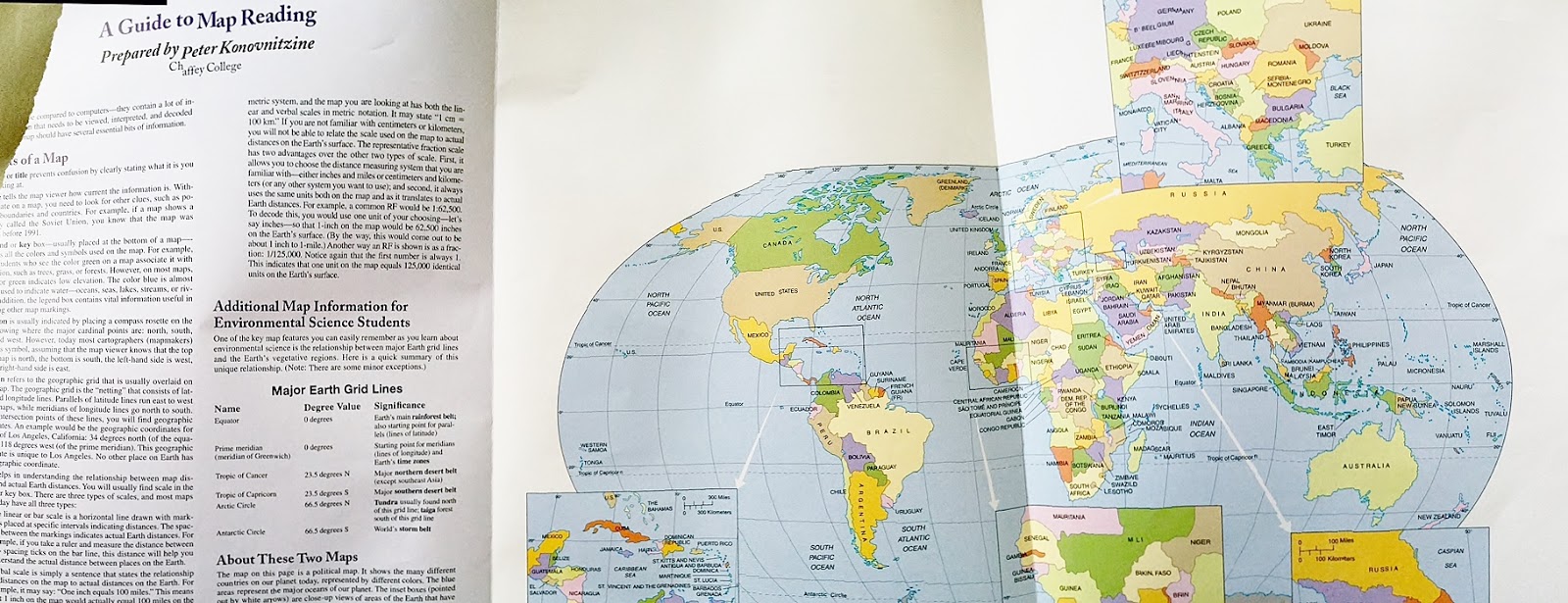
And so I’ve been spending this last week living a bit in nostalgia-land, which I believe every person is entitled to at some points in life. I visited my old college and church, had lots of lunches and coffees and lots of talks, and started going through my old belongings, at which point I realized that I’m a book hoarder. I also discovered this insert from my old environmental biology book, which explains a lot:

A fold out map I found under my bed today.

I also found some old travel pieces from The Inquirer, old essays I wrote for school and lots of notes about random ideas in life. My brain, it seems, has always been running overtime.

One article I had saved was a piece by Rick Steves on the relative simplicity of backpacking in the age of technology, with which I wholeheartedly agree. His last bit of advice was to always keep a travel journal. He observes:

One of my favorite discoveries is that the journal entries I wrote as a scruffy 20-year-old in 1975 still resonate with the…20-year-old American exploring Europe in the 21st century.

I find this encouraging and inspiring. There’s something so liberating and magical about being your own Robinson Crusoe or Sherlock Holmes in a foreign land, even if you can now follow that land on twitter. There’s nothing like being there in person.

And this is why, as a newly jobless post-grad, joining the ranks of the wandering millennials, I feel hopeful about my future. Yes, it is so much more challenging to make things happen now. In college, everything is arranged neatly for you; you have endless options from which to choose. You see your friends all the time. You have access to databases, free Zumba classes, trips to the beach, and all the ice cream you can eat. Those things still exist in life (maybe not the free Zumba); you just have to find them for yourself now.

Look at the map. Look at Rick Steves. We have a whole world still to explore, and even in our own backyard or old college town, we can find uncharted territory. Everything and everyone has a story, and since human beings are naturally curious, it is only fitting that we seek to uncover those stories, no matter where we are physically. If you’re looking for a place to start, try your old journals, essays, or random scraps of paper stuffed under your bed.

🙂

Note:
Rick Steves, “It’s Easier to be a Backpacker,” for the Inquirer, Sunday July 28, 2013. Inquirer.com


An Ode to My Tevas

One of the weird subjects you end up discussing when backpacking are your own feet. Specifically, you talk a lot about footwear. For example, I figured out many years ago that I hate flipflops and would rather go barefoot than wear uncomfortable shoes (which I have done many times). Nothing ruins a trip faster than blistered feet.

The best travel investment I ever made, hands down, was my pair of Teva Women’s Tirra Athletic Sandals (which I have conveniently linked here for you in hopes of getting a kickback from Amazon. Just kidding.) I actually didn’t buy them at Amazon but at a local store in Princeton. I’m sure you can find them at boutique shoe stores and most outdoor stores, too.

The same pair of shoes lasted me through all my hiking in Israel, my fall break in Europe, my walks to class in the US, and all over Southeast Asia until the very last trip I took, to Myanmar, where they finally said “enough.” The stitching between the sole and the ankle strap on the right shoe had unraveled. Even so, I managed to wear them for the remainder of my trip by just velcro-ing the ankle strap around itself. But I decided to leave them at my hostel in Shwan State in order to save room in my backpack. I still think of them there, stuffed in the trash can. It was a very poor ending for a very noble pair of footwear.

I really can’t recommend these shoes highly enough. Many people over the years have asked about them, and I always say how much I love them. We’ve been through a lot together. They are currently in five of my facebook profile pictures. Clearly, I’m obsessed.

So here is one final eulogy to the most comfortable, durable, reliable shoes I’ve ever had. Rest in peace, Tevas.

Dancing with my Tevas in the Golan Heights.

I found you in style, inside a new store
Where brown paper shoe linings littered the floor.
You cost me much more than I then could afford
Yet you tempted me, won me
With cushy, soft soles.

Your velcro and criss-crosses gave me a tan
That’s stayed on my feet through summer and winter,
tatooed shadows reminding me
of hot afternoon climbs.

With socks, you warmed me
in Autumn in Prague.
In water, you carried me
through rocks and through fog.

Up mountains, down valleys,
down cobblestone alleys,
Your grip made me sure
I’d not slip nor unravel.

We spent four long years
foot by side,
we saw ten fine countries,
and a lot of goodbyes.

Till one fine day in May,
your crevices caked with clay,
your velcro delayed
and—riip

Farewell, dear friends,
my trusted travel companions.
I’ll miss your reliability,
your light-weight portability,
your eternal tan-lines.

I hope you enjoy retirement in Myanmar.

With love,
Melanie

PS-Sorry for the stinky feet.

Is Writing Selfish? Or Is It Service?

When trying to live a life of service to God and to others, what room is there for egotism? Where does egotism end and our God-given gifts begin?

**************************************************
I’ve been state-side for one month now, with little to occupy my time other than my own thoughts and the warm comfort of friends and family. As I sit in my little, cluttered home, replete with dog hair and worn-down magazines, I think and pray a lot, maybe too much, about my own future.

I long to continue my education, which leads most well meaning folks to ask me, “what do you want to do as a career?” My usual response is “I don’t know,” which elicits sighs and confusion, mostly from myself.

The truth is, I think I do know, but I don’t feel like admitting it. I want to write. And read. And study. As a career. That seems like something that’s impossible to exhaust…study. One man can’t ever know everything so how much more can we use this life to learn? I think now of one of my favorite little memoirs, Twenty Years A Growin,’ where the narrator gleans this advice to me:

“What good are you unless you study and travel the world while you are in it?”

I take these words to heart and often feel that there’s so much to see and do and learn that I couldn’t ever possibly choose just one path and stick to it. But maybe this is just naivete.

As I contemplate the possible paths before me, I try to see into the future and imagine what would be required of me in a certain setting. How much of myself would I be required to give? How much of myself would I have to die to? In the Christian context, walking with Christ means dying to yourself, taking up your cross (your burdens–see Pilgrim’s Progress) and following Christ.

But how much of me is what I need to die to, and how much of me is given by God to fulfill?

If God gave me a talent for writing or speaking (not saying He did, but I’m certainly no accountant), then shouldn’t I use it for Him? But writing is a very personal activity, and these days I feel like I’m spending too much time alone, in my own head, instead of being present with others.

How much of me needs to die to be filled up instead with Christ?

It’s easy to discern external sins: avarice, greed, addiction, egotism, things that we all struggle with. Sometimes our failings manifest themselves externally in our relationships with others, our addictions to material things, or something else. But sometimes they sink deep inside our skin, and we don’t realize they are there until we try to break ourselves free and instead feel chained to our own sloth, our own internal egotism that sits quietly beneath our breath.

Is this my cross?

If it is, how can I follow Jesus on a path that would confront me with more of the same…the long, solitary afternoons, alone with my books and my thoughts? Our thoughts can sometimes betray us.

Maybe I’m giving myself too much credit. I’m not a hermit…not yet, anyway, and I do love the great outdoors. It’s just that sometimes I love my pajamas more.

Is writing an inherently selfish endeavor? A good writer writes with an audience in mind, with a story to tell, with an argument to posit. Sometimes I just write because I can’t sit still unless I do. Oh, the novelty.

I wonder what it would be like to follow a path of academia, of writing and thinking and listening and learning and trying to convince others I’m right when I secretly know I’m not. Or what if I know I am? Maybe that’s even worse. Or maybe academia, like any other path, is not about being right or wrong but about growing and discovering and being present with others as you walk the road together. Is that naivete again?

What do you think, sage bloggers or writers? How do you reconcile your time in your head with your time serving others? Is writing selfish, or is it a form of service?