
Blog

Du Pain

There is nothing, I repeat, nothing, that smells better than freshly baked bread.

Nothing.

There is also nothing that tastes worse than the limp, plasticky loaves of double packaged grocery store bread that have been sitting on a shelf for at least thirty days.

I wonder, if one ate enough grocery shelf bread, could one live forever, like those loaves do?

Okay, maybe I’m being a bit unfair. I recognize the fact that most people lead far more important lives than I do and have far less time to lie in bed reading War and Peace bake fresh bread every day.

But, thanks to modern conveniences, I am here to tell you that having fresh home made bread need not be luxury, and it can be readily available.
Unless you live in the Mid-south area and would like me to bake your bread for you, which I would be more than happy to do!! Really. Ask me!

Here’s the secret…ready?

TRIPLE YOUR RECIPE.

There, I said it. Because creating sandwich bread dough (artisan loaves are a bit different, though still incredibly easy to prepare…more on that later) takes about thirty seconds, you can EASILY make three or four or more batches of dough AT ONCE, let them rise in separate bowls, bake in the oven, and then freeze the leftovers—or donate them to your lovely extended family, neighbors, strangers, et cetera.

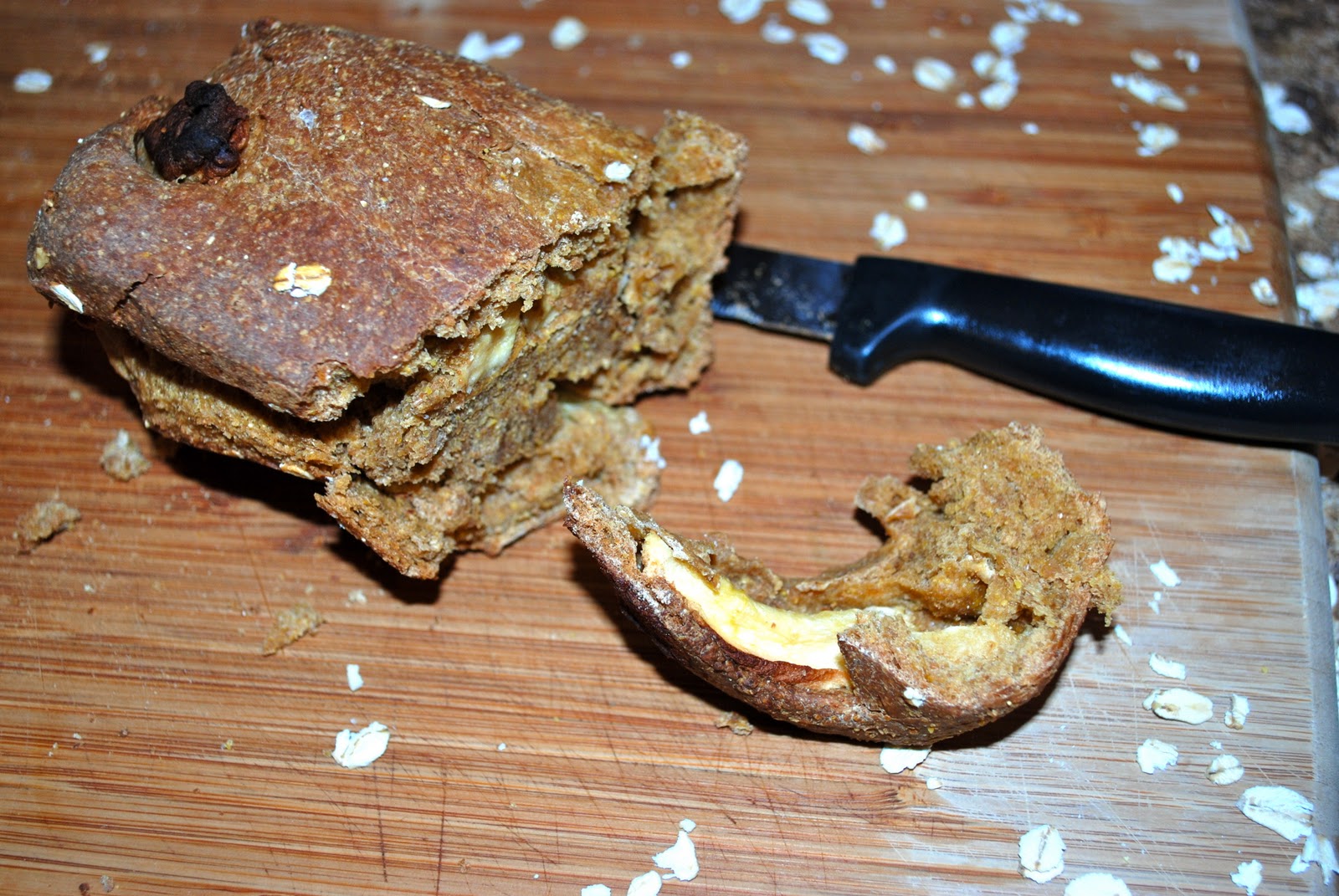
Anadama Bread
Adapted from How To Cook Everything; Makes three small or one large sandwich loaf


Two cups bread flour
One cup whole wheat flour
1/2 cup cornmeal
1/4 cup molasses
One cup goat’s milk, goat’s milk kefir, or buttermilk + 1/4 cup whole milk
Two tablespoons active yeast
One tablespoon salt
1/2 cup chopped dried apples
Two tablespoons grapeseed or canola oil

In your food processor, combine the flours, cornmeal, yeast, and salt. Turn the machine on. While running, slowly add the molasses, oil, and yogurt or kefir. Process until the mixture turns into a ball. Add the remaining milk and let the dough process two or three more times until the milk is evenly distributed. Remove the lid and transfer to a large bowl that you’ve oiled with canola oil. Cover and let rise for two hours.

At this point, you can repeat the aforementioned steps up to three more times, creating four balls of dough. Let them each rise in a separate oiled bowl.

After two hours, punch down the dough(s) and fold in the dried apple pieces. Shape into a ball and let rest on a cutting board, covered, for fifteen minutes.

After fifteen minutes, use the heel of your hand to press the dough into a rectangle. Transfer each dough to a separate loaf pan. Cover and let rise for one hour.

If using one or two batches, heat your oven to 350 degrees. If using three or four, heat your oven to 375 degrees.  Bake for forty five minutes. The dough should be crusty but hollow-sounding when tested.

Your house will smell amazing. Invite guest over and serve them steaming hot slices of bread with butter, marmalade, goat cheese, and coffee and tea. If you have extra loaves, freeze them, wrapped tightly in plastic wrap and foil and in a plastic bag, for up to six months. Store your fresh loaves in parchment paper, not plastic. They will mold that way!

This Is Just To Say

I have eaten

the plums
that were in
the icebox

and which
you were probably
saving
for breakfast

Forgive me
they were delicious
so sweet
and so cold"

-William Carlos Williams

Three Uses for Summer Pea Pesto

I always end up eating my words when I say, sweating underneath the hot October sun, “I just want it to get cold already!” As I type this, I sit hulled underneath a wool blanket in slippers and a sweatshirt. Mmmm, humble pie.


Even with today’s drizzly cold, yesterday was sunny as August and so what better way to reminisce than with some distinctively summer eats?
The freezer is your best friend for these endeavors. Last night I highlighted some frozen white fish in creamy lemon pasta, on top of which, I placed a huge dollop of this:


Summer Pea Pesto
Makes a few cups
One pound frozen peas, defrosted
One clove garlic, peeled
Half of one lemon
Salt, pepper, and dried basil
Extra Virgin olive oil


Place the peas in a food processor. Using a microplane, grate the garlic over the peas.  Add the salt, pepper, and dried basil, and squeeze the lemon, cut side up, into the mixture. 
Secure the lid and process, gently streaming a slow flow of olive oil through the feed tube, until the texture is smooth. Taste and adjust seasonings.


The best part about this dish is how fresh it is, and how easy it is to prepare a little bite of summer regardless of outdoor conditions. Mix it in to any light pasta dish, serve with crackers or crudités, or make this the next morning:


Open Face Egg Sandwich
Serves One
One thick slice freshly baked bread (don’t use pre-sliced sandwich bread for this…or anything, really. Especially this, though, because it won’t hold the toppings. If you don’t bake, buy a loaf from the closest thing you can find to a bakery.)
Two tablespoons Summer Pea Pesto
One slice white cheddar cheese
One teaspoon butter
One egg
Salt and pepper


Place the butter in a small skillet and melt over medium high heat. Once melted, break open the egg into the pan, add salt and pepper, and let it cook for two minutes.


Toast the bread. Spread with the pea pesto and top with a large slice of cheese. 


Flip the white of the egg over the yolk, then transfer to your masterpiece. Add more salt and pepper if desired. Serve with a large mug of café au lait.


I don’t know why this sort of weather makes me want to be in France, but it surely does. More café au lait seems like the proper solution to these problems. 

The Voice

I’m going to be unabashedly honest, because it’s my blog and I can do that.

There is a voice that creeps around inside the mind. It goes by many names. If you’re familiar with the musical Title of Show, you may know it as Vampire. If you suffered from anorexia, bulimia, or disordered eating, God Bless You, you know it as the hated Ed. If you’re Christian, you may call it a demon. I am Christian, but I don’t think it’s demons. I just picked up a copy of The Screwtape Letters last night, so who knows, my opinion may change.

No one knows the origin of this voice. No one knows when, in psychological or physiological development that it first appears. Surely it’s different for each individual person. For some, it may appear as early as five years old, in ballet class, when your daughter notices that her belly protrudes further out in front of her than the other girls’ bellies. Congratulations, she just felt not good enough.

Why? I can’t understand. It’s easy to point blame: the media is an obvious target. The perpetual images crammed in front of our faces, on billboards, in newspapers, on the computer, everywhere we look that isn’t outside at a tree or flower, can stick in our minds like glue to rough skin. But if you’ve ever watched Mad Men, you know that these images manufactured by companies “selling something” did not just appear out of thin air. Advertising companies, product companies, have been catering to populations since they had the tools and the means to, and they took, and continue to take, careful notice as to what consumers are willing and wanting to buy–sex, beauty, love, and companionship, to name a few. These are not recent inventions.

Study antiquity. Study Shakespeare. Study any work of art worth its salt and you will find that it caters to the emotions, the mind, the parts of ourselves that make us uniquely human, the desires that separate us from apes and chimpanzees. I read an article recently that referred to it as the “foolish gene.” It’s the part of us that wants what we cannot see; because, as our logic dictates, there must be something better than what we have in front of us, because if we had it, we would be satisfied. And we are never satisfied.

This gene is not all evil–well, maybe it is, but it has lead to remarkable things. Discoveries. The world isn’t flat, it’s actually round, and there are these giant balls of gas burning millions of miles away from us that give light to our entire planet, which is simultaneously spinning around itself around the most giant ball of gas, and so if I am here and you’re in Antartica, you have one season and I have another, yet we’re both on the same little rock that’s spinning and spinning madly in space, which is, oddly enough, a feat of matter that is too big for our small brains (and yes, they are small) to comprehend, and we cannot survive in it because there is no oxygen and we need oxygen to keep on living.

Phew. That’s a lot to wrap our tiny brains around!

So how is it that the voice in the human mind that encourages us to measure the speed of light and launch huge heaping metal ships into space can be the same voice that can convince us that we are worthless without a certain title of power or a bicep akin to steel, for example?

How is it that some people can smoke all their lives and die at ninety-eight while others contract pneumonia and are dead within twenty four hours?

Life is so not fair.

And it can’t be. I know that. I’m sure you know that, too.  Every time I ever relented the fact to my parents, I heard “Well life’s not fair,” and I could never understand why! If we have control over our actions, surely we can even out the playing field?! But sometimes we just can’t. There is no other explanation for it. Oh sure, we’ll keep on trying to find one. It’s engrained in our “foolish gene.” Just as the great big ball of gas keeps burning, giving me winter while Australians play in the sand, the evil voices will climb all around our brains, working with chisels and ropes and things to try and capture us and keep us prisoner.

Fortunately, or maybe not so fortunately, we have other people’s mistakes to learn from.  We have old wives tales and Pilgrim’s Progress and children’s stories, songs, plays, paintings, poetry, oral tradition, religious tradition, parenting traditions. These things have been going on far longer than you or I have spent on this rock. In fact, they’ve been going on longer than any one person has spent on this rock. It’s foolish to think otherwise, and I know that, and you know that, though we’re so damn stubborn when it comes to admitting it. Because, somehow, for some reason, like our hair and our smiles, it’s in our genes.