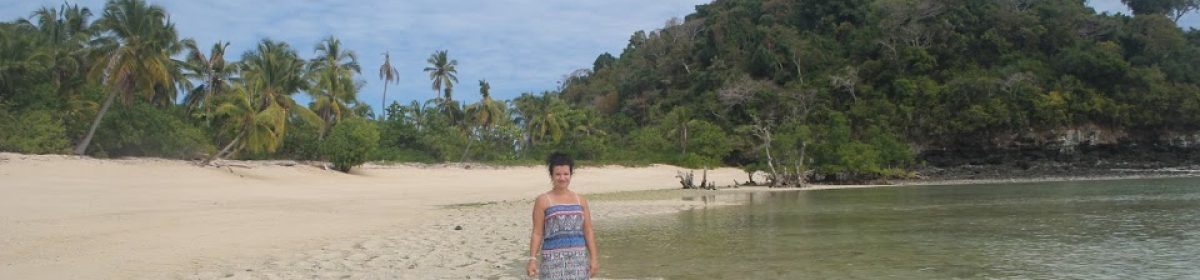
The Savior Complex

“A voice cannot carry the tongue and the lips that gave it wings. Alone it must seek the ether.” –Khalil Gibran


If I had my way, I would be a bird. I would fly from place to place and peep in on other people’s realities, never getting too attached or involved. I would skim the surface of life, laughing at my reflection in oceans and dancing on telephone wires. As a traveler, all I have truly ever wanted is to sit in tiny rooms with friends and drink in laughter between paper thin walls, sweet, steamy chai wafting through our noses and thick, melodious languages dripping from our tongues. But I’m not a bird, and I’m not a wallflower. I exist; people notice me.

I hate that people notice me. Sometimes I wish I could just keep the inspirational experiences in my heart and leave the embarrassing ones behind. I wish I could help people when I want to help rescue them and not when I feel obligated to do so. There comes a point when one can feel so emptied that we cannot seem to be filled. Perhaps this is because “help” has turned into “rescue.”

The world doesn’t give us a break. We can’t decide when people need our help, and we can’t really decide when we need another’s help. But not asking for help when we are drowning doesn’t make sense. Yet how do we move on from a rescue?

No man is an island. But for those of us who have grown up privileged, it’s easy to think that we have some God-given power to help others because of our circumstances, because we’ve been told to go out into the world and make it better. But change isn’t a power, it’s a responsibility, and a very precarious one. If you’re not aware of your own impact, you can do more harm then good.

Reflecting on my time in Thailand, I think I felt a lot of pressure to live up this image of a rescuer that, at the time, I was not aware I had. Being part of a faith community, learning about the plight of refugees, I became very involved with the idea of saving others. I didn’t see it as anything problematic, but I wasn’t just a witness. I was an actor and people noticed me and started assuming things about me that I wasn’t aware of because I was not fully present. I was in my own head. 

I grew up in my head. I dreamed away my reality with visions of waterfalls, open fields, and a sense of life with a purpose. I am learning how to live a life with purpose, but a lot of this has been painful. I think that’s the point. The hardest part about wanting to rescue someone is needing to save them from pain. Sometimes this is absolutely vital; sometimes it isn’t. I don’t know where that line is and I never want to make that decision but I know that I will. Life is tough like that. I have a tendency to remember only the good things and forget the times I failed. But at the same time, failure can be life’s greatest teacher, even if it means giving up and moving home. A friend of mine asked me, “What do you want to learn from this?” I think that’s a great start.

I’ve failed a lot in my life, which is how I know I’m not a savior. I believe there is only one Savior. But even if you don’t, as travelers, teachers, explorers, we have to start acknowledging our own impact. We are not wallflowers and we are not birds. We might be called on to rescue someone, but we need to examine our motivations as well as our plans. Does this person need help? If so, what does that need to look like?

Never stop asking questions.

67
Inle Lake, Myanmar: 2015

How To Convince Your Overprotective Parents That Travelling is Tremendously Useful for Life

Convince your parents that travelling is a-ok.

In response to my last post, I’ve been reflecting on some of the incredible benefits of travelling and some arguments I would make to someone who was not an avid nomad or had maybe watched too much CNN. Here are five ways to convince your overprotective parents (or friends) that travelling is not at all like The Hangover:

  1. Travelling makes you self-sufficient. Unless you sign up for a tour, nothing happens abroad unless you make it happen–booking hotels, finding bus tickets, converting money, deciding to drink the water (or not)…it’s your impetus that helps you get places and stay safe.
  2. Travelling makes you brave. You never know how capable you are until you’re watching the last bus pull away from the station and you have to run after it, screaming and waving your hands like a chicken with its head cut off. You run into all sorts of unfamiliar and uncomfortable situations when in a new place, and you have no choice but to cope.
  3. Travelling helps you be more social. You become far more dependent on the kindness of strangers to get around. Slovakian Grandmothers, Vietnamese construction workers, and Israeli soldiers have become some of my best friends in times of navigational uncertainty (I get lost easily). When you don’t know where you are, you have to stop and ask someone, or in my case, five or six people. I’ve been delighted at the many times I’ve had a genuine conversation (in English, Hebrew, or with drawings in the sand) with a complete stranger. The desire to help people is palpable, and when someone takes time out of his or her day to stop and help you–a stranger–the world seems a little smaller and brighter.
  4. Travelling makes you more culturally sensitive. Visiting religious sites, eating the local food, and observing local customs are all ways that the traveler can develop a keen sense of cultural sensitivity. It also makes you more aware of your own way of doing things by virtue of comparison.
  5. Travelling makes you a better citizen. Less then 10 percent of Americans own a passport, and yet there is so much world outside the coasts. When you travel, you see how the rest of the world lives. You realize how much of an impact Americanism has on the world, how much of American culture is exported and mass produced and interpreted differently. Talking to locals about this helps you form your own opinions about the United States and its place in the world. Being informed is a cornerstone of democracy.

So you see, there is so much more to travelling then Bengal tigers and giant skyscrapers. Going in curious, confident and with a sense of humor can yield tremendous personal growth and a heck of a lot of great stories (to share with those family and friends back home…or not). You don’t need a tour or an itinerary to do it; you just need a good pair of shoes.

Adventures at Home: Trying Out Mountain Biking

 Earlier today I was talking with someone about how I love to write about my experiences but that lately I’ve felt like I haven’t had many exciting experiences to write about. His response: “write about the unexciting ones.” 
 
I attempted mountain biking for the first time without any prior experience. I ended up walking most of the trail, dragging my muddy bike along side me, because I had no idea what I was doing, until I came to a deep ditch full of water. This ditch stared at me, and I at it, for what felt like an eternity. All at once a blue blur of a mountain biker zipped through at high speed, leaving me and my self-doubt behind. Suddenly I heard a voice. “Do you need help crossing that ditch?” The blue blur had stopped. I hesitated, looking around nervously, and shook my head. “Uhh, no, I’m alright,” I stammered in response.  Of course I wasn’t, but I didn’t want to tell her that.
 
But she ignored my obvious lie, turned around and biked back down the hill to where I stood, my weight shifting awkwardly to one side. She zipped past me, splashed easily through the ditch, and came up on the other side. She dismounted. “Don’t look at it,” she said to me. “That’s the key. Whatever the obstacle is, whether it’s a pond or a log or whatever, don’t look at it. Look ahead of it. And just keep pedaling.” I nodded, listening intently to her instructions, debating my options as she spoke. I could just turn around and climb back up the hill, I thought to myself, but that might be awkward. This woman had stopped what she was doing to help me. She was the first mountain biker I had met that day to have done so. I had no choice. I had to go through with it.
 
“Go back a little ways so you can gather enough speed,” she instructed. She was being extremely detailed and thorough. She spoke with confidence. I trusted her advice. “Aim for my bike tracks and look up here.” She raised her hand to her shoulder. Ignoring all signs of impending disaster, I mounted my bike and started pedaling, gathering speed as I rushed down the hill on two wheels, my confidence disappearing like the wind. I looked up at her hand and kept pedaling. The wheels moved like air, without any pressure or resistance. The front wheel dipped down–zippp–and whoosh. Suddenly, I was up on the other side. 
 
“Yeaaaaaah!” I heard behind me. I stopped and turned around. My spontaneous coach was cheering me on with a big grin on her face. “Whatever the obstacle is, just look ahead of it and keep pedaling,” she reiterated through her grin. I was speechless. I couldn’t believe that had worked! “Th…thank you!!” I stammered. She gave me a hearty thumbs up. I turned away and just kept pedaling.
 
The “Tour de Wolf” Trail, Shelby Farms, Memphis, Tennessee


A Trip To Chiang Mai

This trip happened over a month ago, and yet I was in denial about its brevity, so I neglected to write about it until now. But I think I’m finally processing it all!

Over student midterms, for a much needed break from teaching and from city living, I took a trip up north with two friends and fellow teachers. We hopped on an overnight bus to the northern city of Chiang Mai, also known as Thailand’s “second city.” Think Chicago to USA’s New York City, except zero skyscrapers and with an ancient, Asian city wall.

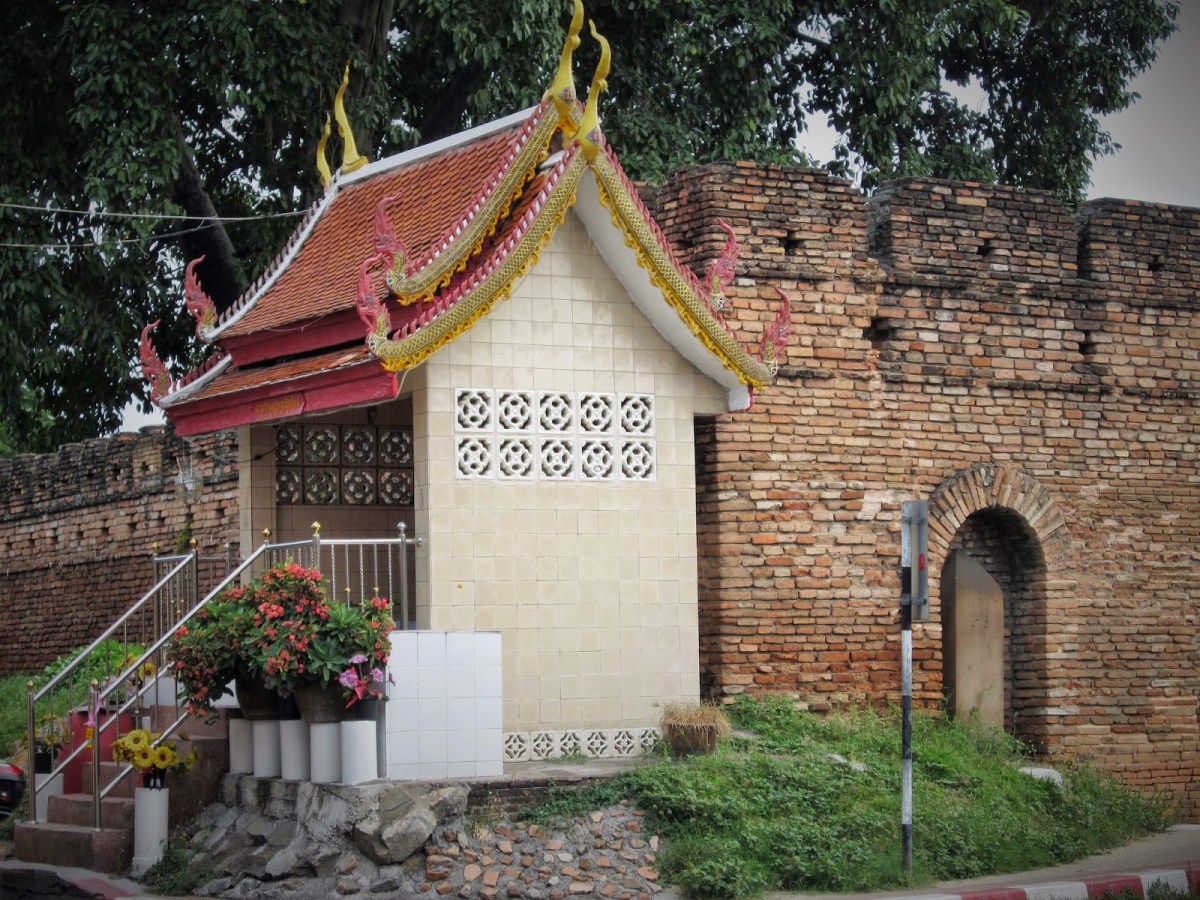
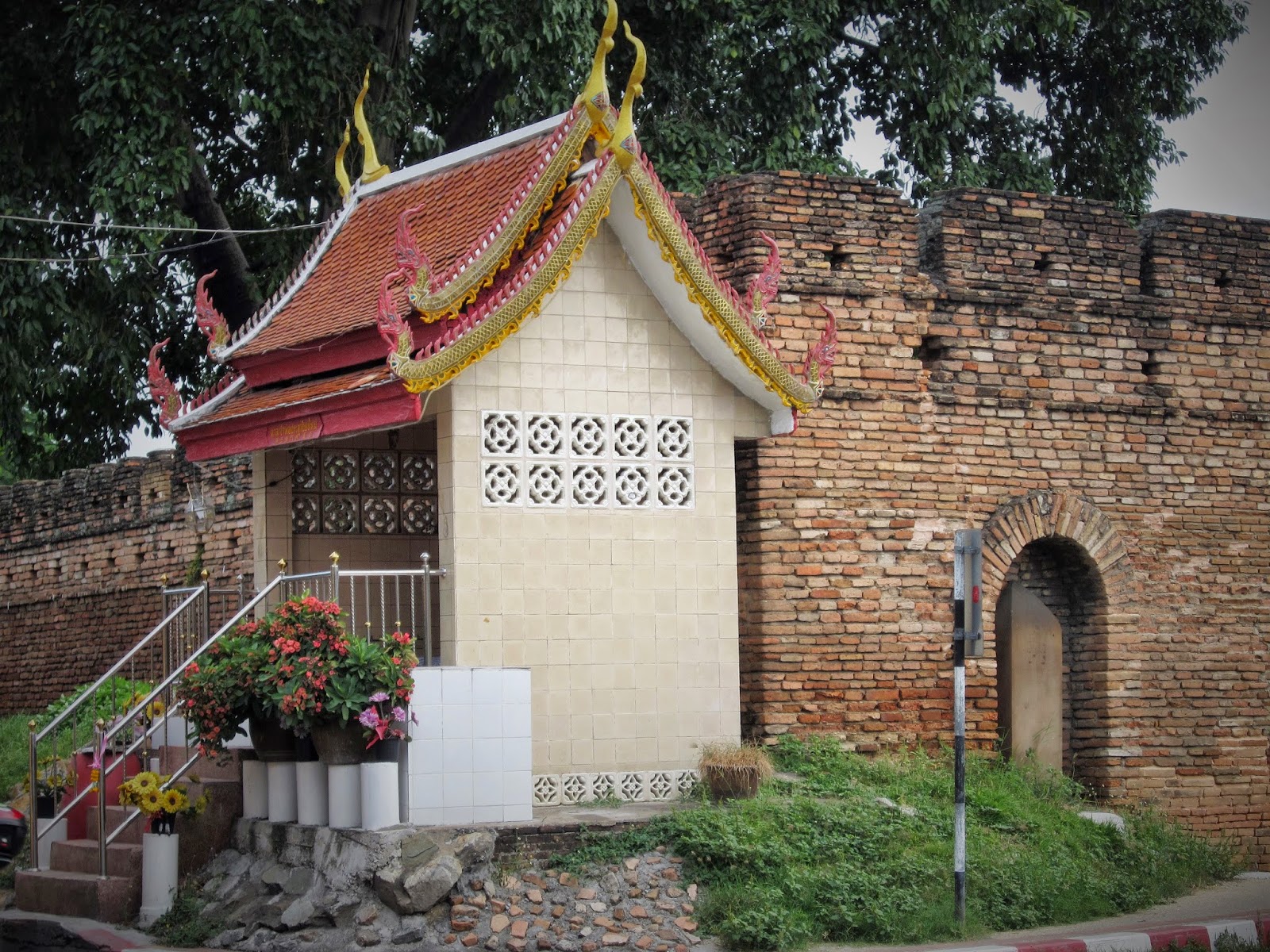
One of the entrances to the Old City.


I love these trees. They’re all over Thailand. They remind me of the jungle.

Chiang Mai is a beautiful mix of ancient history, artistic tradition and modern innovation. If you’re familiar with the term “hipster,” it can almost be used to describe Chiang Mai, except instead of fourteen year olds skateboarding in flannel shirts you see sixty year old Greek and Italian ex-pats smoking rolled cigarettes and playing music in bars. But the feel is basically the same–laid back, adorably ironic and boldly unique.

The night markets were my favorite thing about the city. Sure they were crowded, but here you really see the heart of Thailand’s artisanal craft making scene. Everything from hand woven scarves to purses to jewelry to wooden carvings, paintings, sketchings and etchings were for sale along the streets. And the best part was that you got to witness these crafts in progress. One market, referred to simply as “the night bazaar” features a lower level indoors where brilliant visual artists draw and paint on massive canvases for the entertainment and prowess of curious tourists, all while displaying the capacity of their artistic genius . Of course, in true artistic fashion, you can’t take pictures of the work, so I leave it up to you to imagine wall to wall paintings of children, old men, Buddhist monks walking to temples in the rain, elephants, rice fields, wolves, Cherokee people and the like, all in the most beautiful colors and black-and-white charcoal depictions I’ve ever seen.

For me, the biggest treats of the trip were actually outside of the city. The first was a Thai cooking class at a special, homegrown farm in the mountains:

Our group enjoying our delicious creations.

But the second was far more edifying and less simplified. My two friends and I elected to go on a three day, two night “trekking tour” in one of Chiang Mai’s beautiful mountain terrains.  The morning of the first day, we were driven to an elephant camp that, unfortunately, did not treat the elephants humanely. I will refrain from posting pictures here. Needless to say, I learned a lot about the benefits and complications of the Thai tourism industry on that day.

Yet our journey grew increasingly authentic and unpredictable after that. We drove to our beginning pathway and hiked to a beautiful waterfall for lunch. After a quick dip, we continued on, our quick footed guide (nicknamed “Louis” but pronounced like the French) always stopping to point out tasty snacks like fire ants (I’m not kidding) and various kinds of mushrooms.

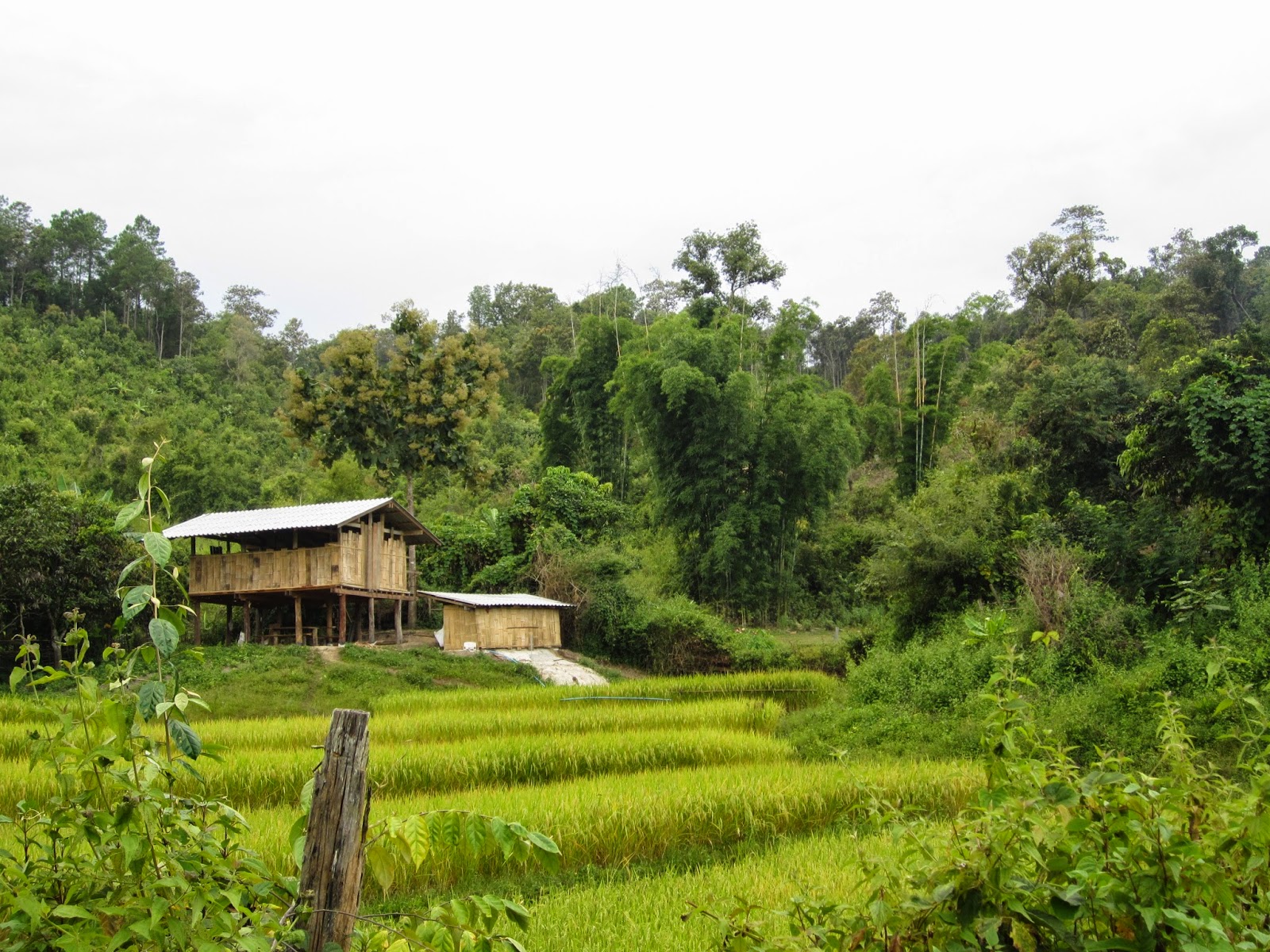
That evening we arrive at a small village belonging to the local Keren people. The Keren originally migrated from Tibet, settling first in Burma and now in northern Thailand. They speak their own language, though their alphabet is similar to Thai script. Our guide, Louis, belonged to a neighboring village but was treated as one of their own, and they extended the same warm hospitality to us.

Our guide Louis…jokingly feeding me a bottle of water.
Inside the cooking room.

After a luxurious sleep on straw mats, listening to the rain patter on the bamboo rooftops, I slid my way up the dirt path to rejoin my group for breakfast and our second day of hiking. Day two proved to be very, err, wet, as we encountered a serious downpour about an hour into our hike with no shelter in sight. Nevertheless, we soldiered on, and thank God for Louis, who was able to guide us through steep paths that had quickly turned into raging rivers. We made it to our second camp for lunch.

Before we left the Keren village, we passed through the local school, where we peeked in on children learning Thai language songs. I had forgotten what it felt like to be around children (having spent the majority of my time with college students), and I wanted to cry seeing the sheer joy on their faces. I’m including a facebook link to the video that my friend, Emi, took, because seeing them was such a beautiful reminder of what all people share in common. We may all have different words for “head, shoulders, knees, in toes” but those precious body parts are what we all have and need to protect.

I’m eternally grateful for the trip to Chiang Mai, and most especially to the Keren people for letting me into their homes for a little while. Being there was a great reminder of why I came to Thailand in the first place. Yes, I love English, and I really like teaching, and I have my beliefs. But what I have to give pales in comparison to what I have to learn just by meeting people. Sure, it can be uncomfortable–like walking through the pouring rain–but on the other side, always, always the sun comes out and dries up all my insecurities.

It’s been four months since I arrived. My first semester of classes are coming to a swift and jarring end. There are days when I feel completely, inexplicably ordinary, when I forget that I’m in Thailand all together, and it feels like just another day. I think these days are important to keep my sanity at a healthy level. But far more important to me are those days–precious few they may be at the moment–that take me outside of the ordinary and into some of the ancient and secret worlds of God’s creation. I pray that He will give me the courage to pursue these extraordinary moments with as much vigor as I try to pursue the ordinary.

With love,
Mel