Post-Grad: Making the Best of The Time You Have

A cliche title, but this is how I feel right now…

And once again, boxes are packed and suitcases are standing in my bedroom. Where I am going this time? It’s tempting to say “nowhere,” but that isn’t true. I’m moving back home.

Such a short sentence carries with it so much weight and societal pressure, doesn’t it?

I’ve been blessed to spend some time with my wonderful college friends this weekend in New Jersey, where I’ve been for the past week, packing boxes, visiting family and tying up loose ends before I move back to Memphis. One of the things we talked a lot about is how odd it is not to have that structure of school looming over us. This time of year is when students move back to campus, start planning their courses and their extra-curriculars, and begin that carousel dance of “what ifs” and wishes for their still mostly ethereal futures.

Only this time, and for the first time (since I graduated college and then went straight to teaching at a university), there is no class schedule to pick! No courses to look forward to, no projects to plan, no books to check out or social events to make. I try and tell myself that I’ll still be as studious, reading for pleasure and edification and cross referencing everything I see on paper. But the truth is, even in the month and a half since I’ve been jobless in America, it’s been really difficult to create any sort of routine that challenges me.

All of my caring older adult friends and family will smile and shrug and say encouraging things like “you don’t need to know what you’re doing forever; you just need to know what you’re doing next.” And this is true, and I’m very grateful for their understanding and support. Yet I’m wondering if this is the part of life, that dreaded post-college part, that people don’t really explain in detail because it’s different for everyone, and maybe uncomfortable as well.

And so I’ve been spending this last week living a bit in nostalgia-land, which I believe every person is entitled to at some points in life. I visited my old college and church, had lots of lunches and coffees and lots of talks, and started going through my old belongings, at which point I realized that I’m a book hoarder. I also discovered this insert from my old environmental biology book, which explains a lot:
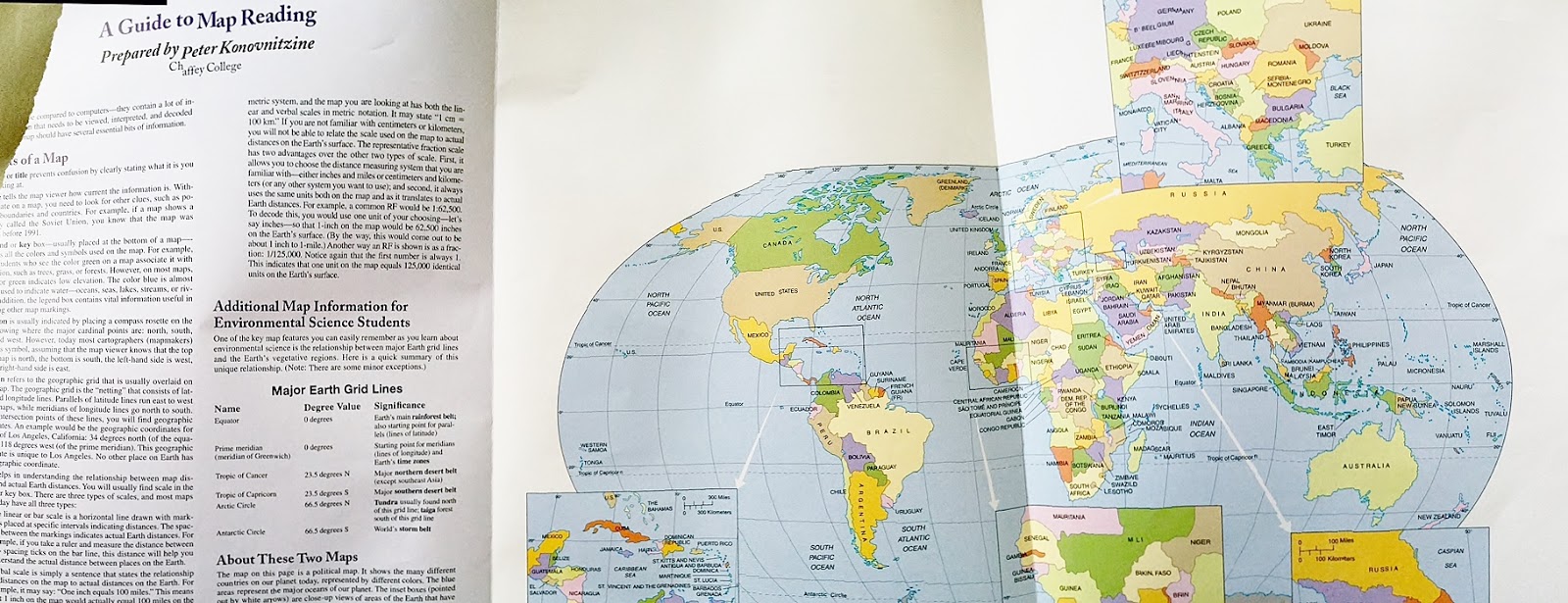
A fold out map I found under my bed today.

I also found some old travel pieces from The Inquirer, old essays I wrote for school and lots of notes about random ideas in life. My brain, it seems, has always been running overtime.

One article I had saved was a piece by Rick Steves on the relative simplicity of backpacking in the age of technology, with which I wholeheartedly agree. His last bit of advice was to always keep a travel journal. He observes:

One of my favorite discoveries is that the journal entries I wrote as a scruffy 20-year-old in 1975 still resonate with the…20-year-old American exploring Europe in the 21st century.

I find this encouraging and inspiring. There’s something so liberating and magical about being your own Robinson Crusoe or Sherlock Holmes in a foreign land, even if you can now follow that land on twitter. There’s nothing like being there in person.

And this is why, as a newly jobless post-grad, joining the ranks of the wandering millennials, I feel hopeful about my future. Yes, it is so much more challenging to make things happen now. In college, everything is arranged neatly for you; you have endless options from which to choose. You see your friends all the time. You have access to databases, free Zumba classes, trips to the beach, and all the ice cream you can eat. Those things still exist in life (maybe not the free Zumba); you just have to find them for yourself now.

Look at the map. Look at Rick Steves. We have a whole world still to explore, and even in our own backyard or old college town, we can find uncharted territory. Everything and everyone has a story, and since human beings are naturally curious, it is only fitting that we seek to uncover those stories, no matter where we are physically. If you’re looking for a place to start, try your old journals, essays, or random scraps of paper stuffed under your bed.

🙂

Note:
Rick Steves, “It’s Easier to be a Backpacker,” for the Inquirer, Sunday July 28, 2013. Inquirer.com


Out of the Frying Pan, Into the Fire: Pakistani Asylum Seekers in Bangkok’s Neighborhoods

Hi friends,

This is a long post, but I encourage you to read to the end. This topic has been weighing on my heart for some time, and I’ve finally put together some information about it. Please read, comment and contact me with any questions or concerns. 

I knew essentially nothing about Pakistan before I came to Thailand. Nor did I think that living in Thailand would teach me anything at all about a country in central Asia for which I had no frame of reference or real concern, or make me care so deeply for a people I had never met.

But God works in mysterious ways.
I began attending a church that ministers to some refugees in the area. I joined a small fellowship group through the church’s network, and one of these families was in my group. I had just moved to Thailand, and I was feeling very lonely. This family saw the loneliness I was carrying inside me, and they invited me over to their home. I went, a bit nervous, but was welcomed with the most genuine Christian love and hospitality I have experienced in many years. It didn’t matter that their home consisted of two small rooms with one big bed on the floor—which they converted into our dining table. They showed great appreciation for my company. In reality, I appreciated their company more than they knew, and I kept going back to sit and visit with them. Sometimes we would sing or play music. Other times we would play chess. Always we laughed and prayed, and there would be delicious food and tea. They told me many stories about their lives back home. They told me of their persecution and how Muslim Extremists had registered the blackened 295-C legal case against them: The Blaspheme Law against the Muslim Prophet Mohammad. In Pakistan, anyone accused of blasphemy receives execution. So the family fled to Bangkok.
In Bangkok today, there are approximately six thousand asylum seekers from Pakistan, most of whom have been accused of violating the Blaspheme Law. They come to Thailand because it is very easy to enter on a tourist visa. However,  as soon as those visas run out, they are regarded as criminals. 
Thailand, to this day, has never signed the UN Commission of Refugees;  this means that every asylum seeker and refugee, regardless of their status under the UNHCR (the UN High Commission on Refugees), is illegal. In the last month, police have arrested hundreds of families and thrown them behind bars. Last week I visited the Immigration Detention Center; the “prisoners” are detained in hot, overcrowded rooms. They are let out to walk around the building only twice a month, and they have extremely limited contact with the outside world. They have no clean drinking water, receive meager meals and very limited medicine. There is a host of diseases inside. It’s a terrible place to be, but for most, it is their only option. The only way out is to be granted refugee status by the United Nations, a process which takes years, or to go back to Pakistan.  There is no choice but to suffer in prison. It is a terrible, terrible place.

Yet despite these struggles, something remarkable is happening. Communities of asylum seekers are uniting to create lives for themselves and their children. They may not be in control of their futures, but they can change their present circumstance, through faith, perseverance, friendship and sharing their stories. And they are doing just that.

 ************************************

Last year, my friend opened a makeshift school in his one room flat for the neighborhood children to learn. The school has grown to reach of 140 children all over the city. A few months ago, I went and taught drama lessons to some of the children. Their enthusiasm, excitement, and sharp wit brought me to tears (not in that room, of course. I had to be cool. They are teenagers, after all.) I miss them. I hope to see them again. I haven’t been back, because the learning center had to shut down. Thai police began patrolling the neighborhood round the clock, and most families were too afraid to send their children outside.

Still, God works through the darkest circumstances. He brought these children out of Pakistan. He has delivered them from incredibly dangerous situations. He has opened four learning centers, one of which was given generously by the wife of a high-ranking Thai army official. The Lord works in miraculous ways.

When I visited the IDC last week I had the honor of meeting other residents of Bangkok who are doing their best to care for the detainees however they can. They work under the constraints of the visitor’s rules and regulations to deliver home cooked meals, diapers, water, food and supplies to as many people as they can.

So why is this so important? Well, being here has showed me with my own unbelieving eyes how powerful prayer is. Most of all, these people need our support and to know we love them and our thinking about them. Even if you don’t pray, just sending some thoughts, or talking to a friend who may not know what’s going on, can do tremendous things to alleviate the suffering of people who feel so alone. And somehow, I feel like I’m here to help.

************************************

For more information about the situation, I recommend the following articles:

http://bigstory.ap.org/article/907aad6cecba463794926748e1fb4369/stuck-limbo-bangkoks-hidden-urban-refugees-scrape

http://farrukhsaif.com/crack-down-against-pakistani-asylum-seekers-in-bangkok-thailand/

http://liferaftinternational.org/about-us/the-situation-in-bangkok

With Love,
Mel