What I learned from Travelling in Vietnam

What I learned from Travelling in Vietnam:

1. Culture shock is real, even if you only stay in a country for ten days.

2. Ten days is not nearly enough time to appreciate all that Vietnam has to offer.

3. Vietnam is diverse. The south is hot and humid, much like Bangkok. Yet the North feels cleaner, calmer, and crisper. It certainly was colder! I never left the hotel without a sweater, a jacket, and two scarves. But then again I’m used to the 80 degree (F) winter in Bangkok 🙂

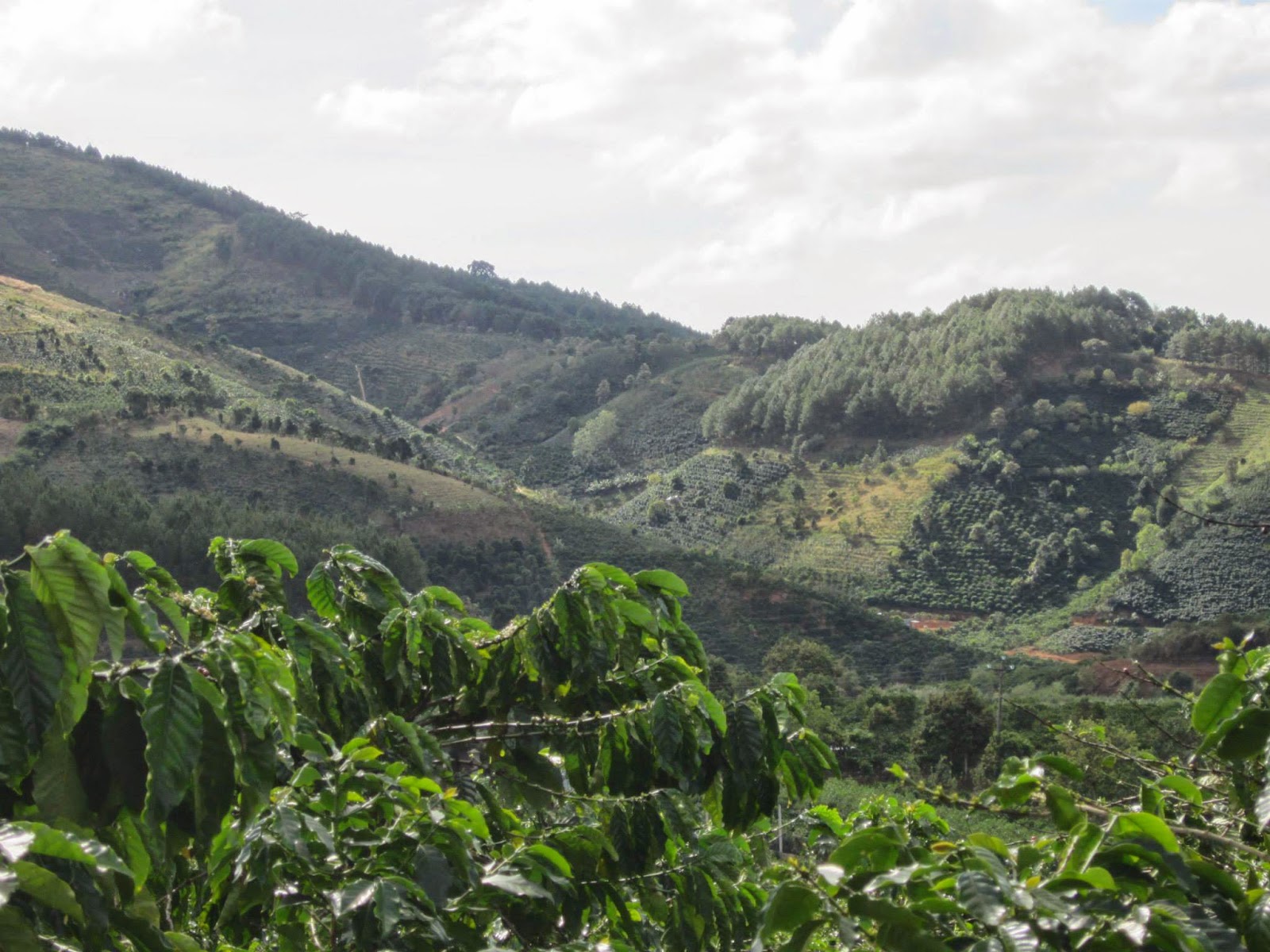
4. The landscape is incredibly diverse as well. The south is full of dense, tropical forests and muddy river deltas. The center boasts pristine mountain peaks with some truly exquisite views, and more coffee plantations than I have ever laid eyes on in my life!

Some of the many hills lined with coffee plants.

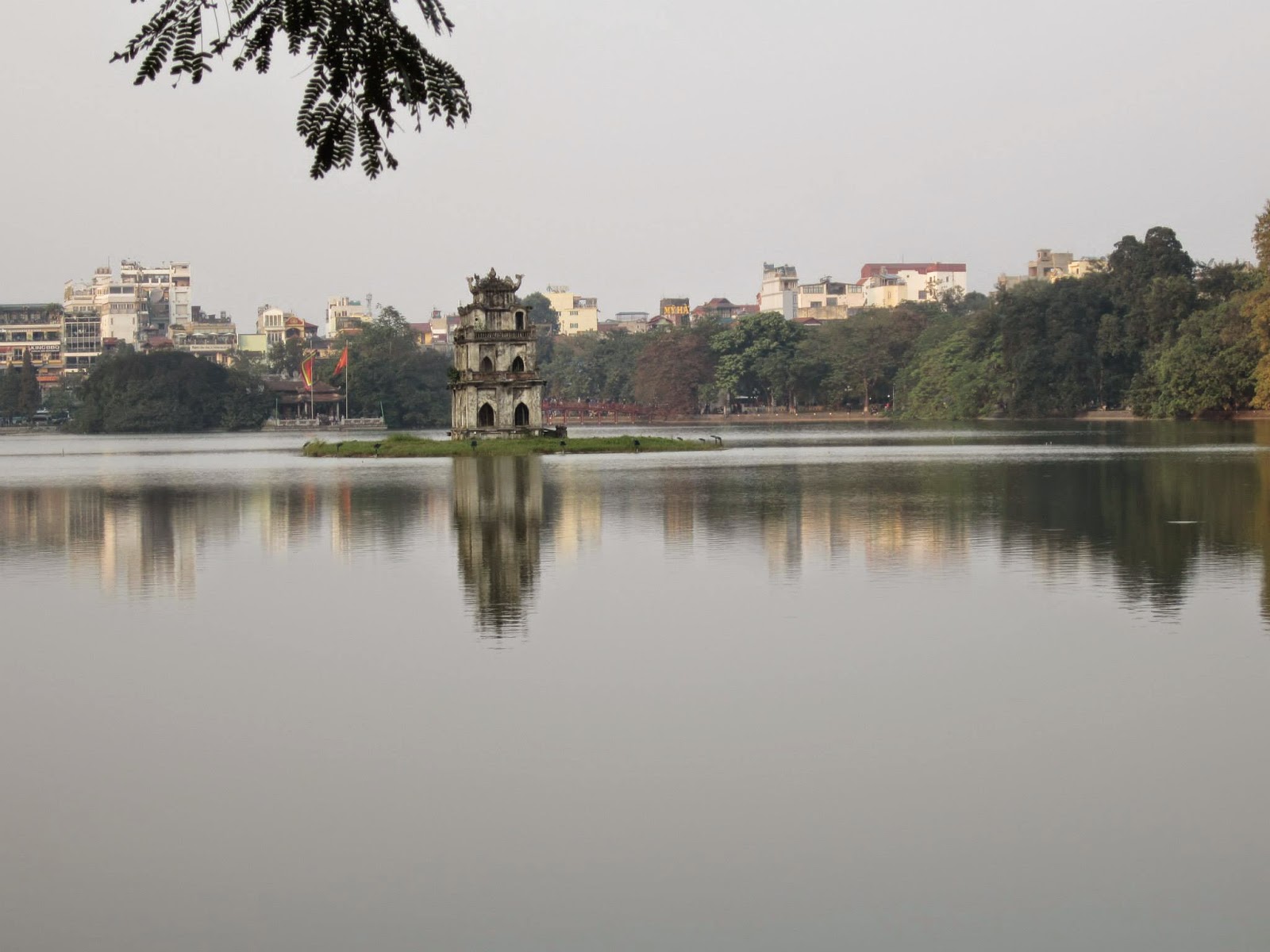
5. The capital, Hanoi, has a “petit Paris” feel (due to a century of French colonialism), but the abundance of motorbikes and confusing street names will not let you forget that you are, indeed, in Southeast Asia.

Getting a chuckle out of linguistic diversity.

6. Vietnam is industrial, noisy, hectic and yet somehow still charming in an unintentional sort of way. I think most of the charm, at least what attracted me, came from the fact that a lot of people live exactly as they always have before opening up to the West, and so you don’t feel the insane effects of commercialization that you get in Bangkok. Most locals seemed to have little regard for regulations or standards and simply went about their business as they pleased. Charming, and yet frustrating, especially if you are the one trying to do business with someone.

7. Things are authentically inauthentic, like the little “Italian” restaurant where I ate my Christmas eve dinner. The food was questionable, and I’ve never had a caprese salad with olives in it before, but still I loved it for its unintentional charm. The old, gray haired Vietnamese man carried the little wine glasses with such pride, and the old maps and Etruscan pictures on the walls relayed a true passion for all things Italiano…even if he didn’t actually serve the promised gelato.

Enjoying a new recipe for caprese salad.

8. Christmas is not Christmas like I had ever experienced it. To most people in Vietnam, Christmas is just an excuse to party, kind of like Americans do on New Years eve, Halloween, St. Patty’s Day and virtually all non-religiously mandated holidays.

9. Foreigners are almost always charged twice the normal price, because everyone assumes that you are rich, even if you are not. Still, according to Vietnamese standards, you probably are.

10. I have never been anywhere like Vietnam. Even Cambodia and Thailand, its close neighbors, differ so much in spirit, charm, history and life-force. I’m not sure if I’ll ever make it back. But I am really glad I went.

Hanoi, the capital city.

With love,
Mel

Cambodian Complexities: I have a feeling we’re not in Thailand anymore, Toto

Today I’m typing from a close friend’s apartment in the Udom Suk neighborhood of Bangkok. Yesterday I walked through graves in Cambodia: the Killing Fields, one of many sights where the Khmer Rouge, Cambodia’s most notorious mass-murdering regime, slaughtered hundreds of thousands of innocent Khmer people not more than thirty five years ago. As I walked, my audio tour guide gently reminded me not to step on any bone fragments, as such remains tend to surface after the rainy season and the soil shifts. I couldn’t take any pictures ( I was allowed to take pictures, but emotionally I could not), but I found part of a jawbone with a few teeth lying half-exposed beneath the dusty soil, and pieces of what looked like arm or leg bones appeared near by.

I have a feeling we’re not in Kansas anymore, Toto.
The complexities of Khmer culture, both ancient and modern, overwhelmed me as soon as I stepped off the bus in Siem Riep. Before that, as my bus chugged slowly across the border from Aranyaprathet, Thailand into Cambodia, I was surprised at how similar it felt: rows of young and old women selling fruits and snacks, car repair shops and convenience stores dotting the drab, dusty landscape. But as we left the border town, I was struck by verdant beauty: miles and miles of lush rice paddies, palm trees and mangroves. Milky-white cows grazed on bright green grasses as local farmers squatted by their rice crops preparing to harvest. It was so calm, and it was so beautiful. I felt a sense of peace I hadn’t felt in a long time.
Yet when we arrived in Siem Riep, the town closest to the famous Angkor temples, I realized that things operate differently here. First, there were no taxis–two or four wheel–in sight. As soon as I was off the bus, twenty or so men approached me asking if I needed a tuk-tuk, which is a motorized rick-shaw, the Cambodian answer to taxis. My first instinct was to walk away and search for a “legitimate” taxi driver, but as I did so I noticed that there were no taxi drivers. There were only rows of tuk-tuks parked along the street. I guess there was no other option. 
As it turns out, there isn’t, at least if you’re a foreigner, and especially if you want to see the Angkor temples, about 15 km outside of town. My first morning there, on the way to Angkor Wat, I turned around in my seat and couldn’t help laughing: a sea of tuk-tuks paraded down the road behind us, fading into the horizon, as if this were a rehearsed, daily ritual. After spending a few days in Siem Riep, I believe this is exactly the truth. The part of Siem Riep that I saw seems to have been constructed entirely for foreign backpackers, and the glow-in-the-dark signs that hang overhead state my case: “Night market” and “pub street” illumine two crossroads like cheesy Christmas lights in a shopping mall. Rows of rowdy pubs with a ninety-eight percent foreign clientele make it hard to believe that this is still Cambodia, the small and ancient country that was up until very recently a United Nations protectorate. 
It’s easy to forget this if you stay in Siem Riep, but as soon as you leave–on a drive through the countryside if you have a nice tuk-tuk driver who’s willing to take you, or on a speedboat down the Tonle Sap–you realize how poor most of Cambodia is, and it hits you in the face like the hard, strong sun. Most of Cambodia’s people are farmers–not commercial farmers, but subsistence farmers. Many take boats into the Tonle Sap river to fish and sell their findings at market, but they rarely make a large profit. I’m no expert on Cambodian economics, but I know that, materially at least, most of these people have very, very little. 
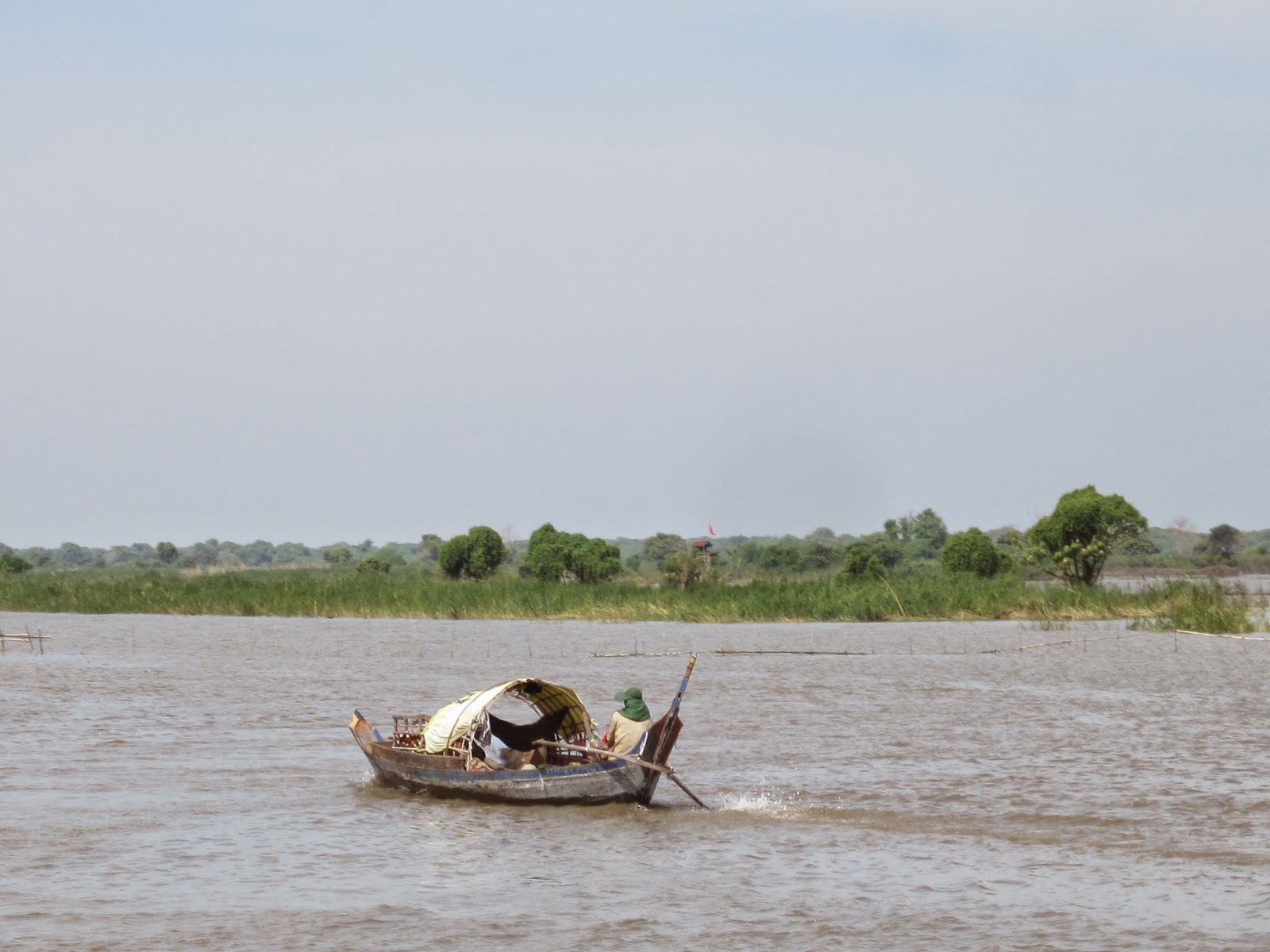
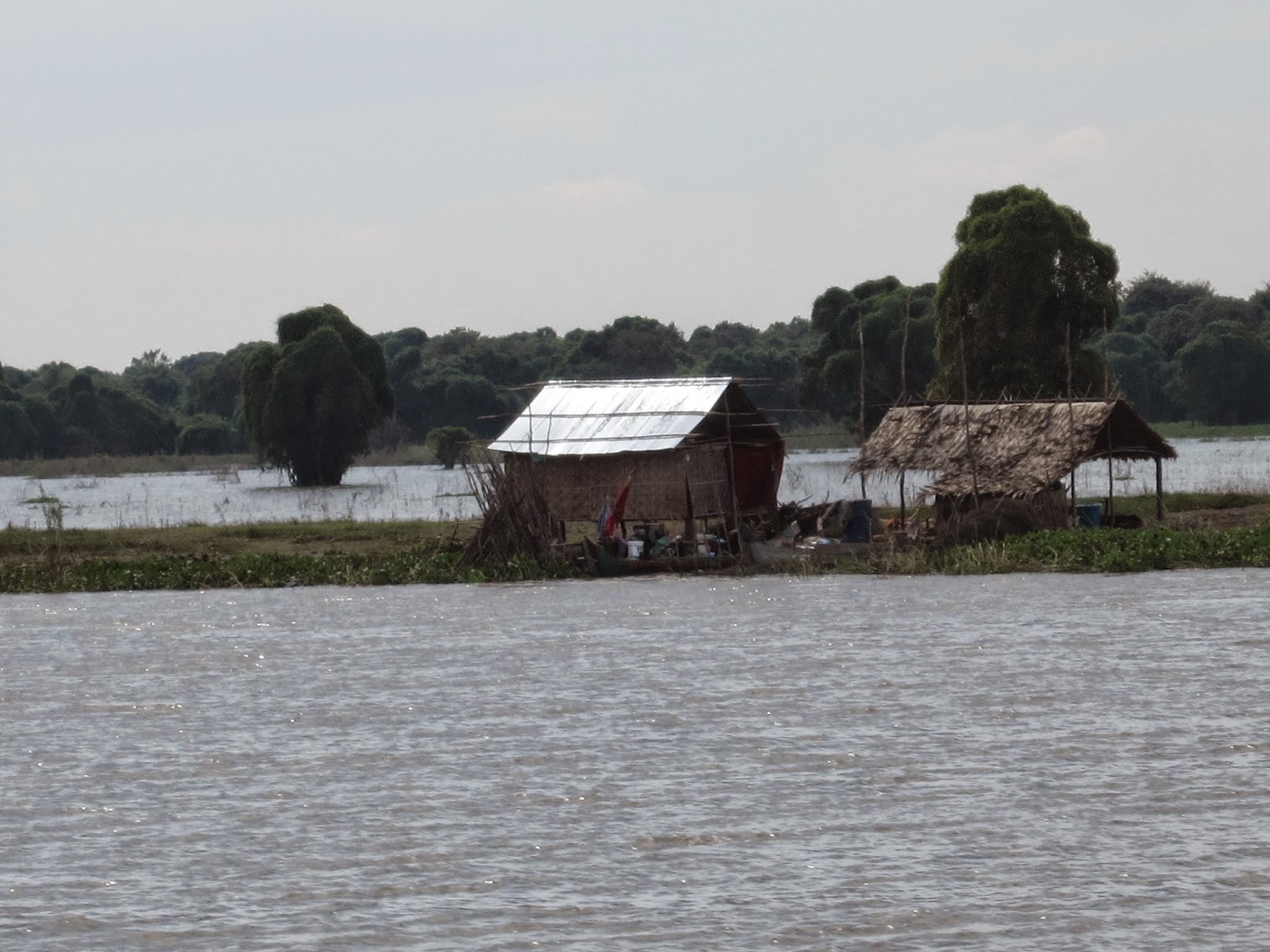
Still, I couldn’t help but be taken in by the natural beauty and picturesque tranquility of the fishing villages that dotted the landscape as my speedboat whirred past. Mangrove forests, floating houses and family fishing boats came to greet us like beacons into another world. This was truly foreign to me–a lifestyle so untouched by modernity, yet so at peace with nature. I admit I felt jealous of them. 
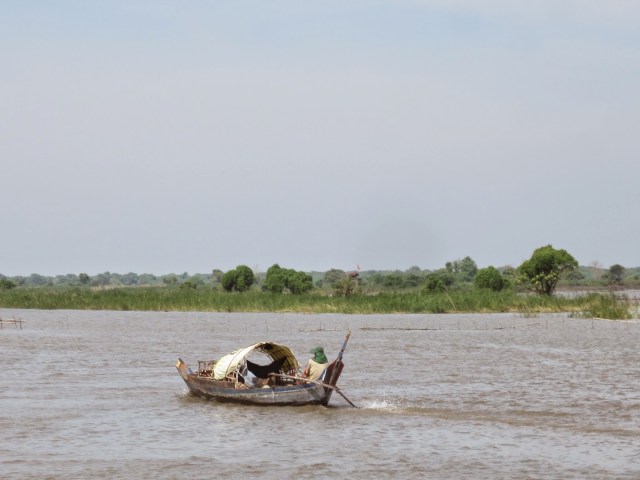
One of many fishing boats we passed. 

Homes built along the water. These are not built on stilts, though most houses are, to protect from floods.

There was something that appealed to me about this lifestyle. And yet I wondered what they thought of me and the other tourists in the boat. As we passed, many of them smiled and waved. I wondered how genuine was this gesture. There’s no way of knowing, though to me it felt truthful. And that, in the midst of everything else, made me feel welcome.

There was one more place I had to visit before I left Cambodia.  I know most people don’t travel for the museums, but I do. Having written a paper on the Cambodian genocide last spring, there was no way I was going to Cambodia without visiting Tuol Sleng, the former prison and interrogation center of the Khmer Rouge.
Tuol Sleng, or S-21 as it is also known, stands in the middle of Phnom Penh, the capital city. From the outside, it is nondescript and seems to blend in with the other beige cement buildings around it. But as soon as I stepped inside I felt chilled. Tuol Sleng used to be a high school; it was built in the sixties during a brief period when Cambodia had a sovereign leader, before the civil war began. When the KR took power, they emptied the city and turned Tuol Sleng into their interrogation headquarters. Here, they imprisoned and tortured thousands of innocent people: members of the opposition government, those with educations, those with glasses, and their families. They also imprisoned a string of westerners here. Their testimonies remain, displayed on the third floor in the original Khmer script for all to see. The kinds of confessions people made up are absurd. The whole thing is absurd. It’s impossible to comprehend.
So I just cried. I cried a lot, and I couldn’t really stop, but I told myself to keep it together, because these stories needs to be told. I felt so grateful to the hard-working men and women who are now running the museum and guiding tourists like me; they have a great responsibility to share these stories. It’s chilling and gruesome to walk through the prison cells, and even worse when you continue on the 15 km journey outside of the city to the Killing Fields, where the mounds dug as mass graves are still deeply imprinted in the earth. I don’t think I had ever been that close to human bones before. It’s a terrible sight. 
So what now? I left Cambodia early; I didn’t want to stay. I confronted reality, and it overwhelmed me, so I left. But for the million and a half that died under the KR, and for millions still living in poverty or under threat of land-mine explosion today, they can’t leave. This is their reality. 
I didn’t stay long enough to ask anyone about it. My tuk-tuk driver, Alex, told me a little about his life as a boy. He is twenty-six years old, and his parents survived the Khmer Rouge. But he didn’t talk about how. He told me how he used to go on the Tonle Sap every day in a boat to fish for extra food to sell at market. He said they were very poor. 
Sympathy, empathy, guilt and a host of other feelings overtook me during my five powerful days in Cambodia. It’s a lot for anyone to stomach, and I try not to shame myself for it, though I wish I had answers and cures. If all I can do right now is to tell this small story to someone else, then I can be happy with that. And maybe you can share this with someone else who may not know about it.  I visited Cambodia, and I found a world that was simultaneously untouched and hopelessly crushed by modernity. It isn’t fair. Cambodia is so beautiful, and I wish I had stayed for a much longer time.

If you’d like to read more about Cambodia’s recent history and to learn about excellent recovery projects like Land-Mine removal, I recommend these sights:
De-mining efforts in Cambodia (this contains information about the Land Mine Museum near Siem Reap, which I also visited. It chronicles the efforts of one former KR child soldier in de-mining Cambodia and helping land-mine victims. Absolutely worth a visit if you are ever in Siem Reap). 
The Time Has Come (The Walrus Said) to talk about Home Sickness

It’s finally happened.

I’m homesick.

The feeling has been creeping on slowly like a cold for the past few weeks.

I’ve been trying my best to combat it. I’m taking regular doses of social events, drinking lots of classroom prep, and getting at least 8 hours of Thai commuting a night, but still, even through preventative medicine, I’m homesick.

I know I shouldn’t be. I have regular access to the internet, Skype, Whatsapp, and I’m sending postcards. But frankly, I’m beginning to wonder if my internet addiction is actually fueling my homesickness. I’ve noticed in the past few weeks that I’m spending more time in my apartment with my face glued to facebook or gmail or even the Huffington Post than outside making new friends. Today I saw an issue of TIME magazine for the first time since being here, and I gobbled it down like a sickly sweet dessert. To be honest, making friends takes work, even in one’s home country, and sometimes I just don’t feel like expending the energy to talk with more people. Some days, I’m really talked out.

Additionally, being here has made me much more aware of my Western-ness. I’m an English speaker, I thought to myself today, and that categorizes me in the eyes of so many people, most of whom are not (native) English speakers. Today, for example, I received this well intentioned but unsolicited advice from a fellow (Thai) teacher while grabbing a juice in between classes:

Be careful. Don’t go outside alone, because you know, Thai people, they kill foreigners.

I smiled politely and paid for my drink. Then I left, feeling confused as to whether that was a warning or a threat.

Things like this happen all the time–not quite to that extreme (and by the way, my experience with Thai people so far couldn’t be further from this apparent “truth”), but I’m often singled out for my foreignness. Most of the time I just laugh it off, but deep down, sometimes it gets to me that I’m judged for my appearance without people bothering to talk to me first.

Then of course, there is the whole language barrier thing. Suddenly, everything I studied in my history classes makes sense. On the one hand, I’m very grateful for the opportunity to feel like I don’t belong. In this day and age, with migration and immigration and asylum seeking abounding, I can’t imagine how confused and scared and misplaced refugees, migrants and immigrants must feel in any country other than their own. And on the other hand, sometimes it’s just plain irritating.

But I’m learning a lot. For instance, I know that I can successfully direct a taxi driver to my given address with the help of a GPS and a rudimentary knowledge of Thai direction words. I know that Thai people smile in all sorts of situations that I would normally find confrontational or irrational. And I know that when the power goes out, there’s nothing you can do but pray by the light of your cellphone.

But I’m still not really getting it yet. There’s still a million things about Thailand’s bureaucracy that don’t make sense to me, and I wonder if they make sense to anyone else either. And I still marvel at how the sky can just open up and pour rain sideways until the roads start to smell of sewage.

All this, and I’m only on month two.

I’m trying to find a way to wrap this up, but I’m not finished yet. I’m struggling to give myself encouraging words. How do you deal with homesickness? Does it help to talk to your family more or less? Does it help to get out in the real world, close the laptop, and go make a new friend?

Or does it help just to get a good night’s sleep?

I’d really love to know. For now, I’m looking forward to the upcoming break; hopefully I’ll finally get to go exploring.

Mel

"They Have Pizza in Thailand?"

In trying to convince my parents that I am living comfortably as a teacher in Thailand, I’ve been telling them all the familiar things. “Yesterday, I went shopping. I bought linens, and I had pizza for dinner with friends.”

“Really? They have pizza in Thailand?”

They do indeed.

But make no mistake about it; I am in a foreign country, and with that come many highs and lows. I feel so comfortable at church, speaking English with my friends, and yet as soon as I enter a van I am dropped down to the level of humility it takes to remind me that my language is like that of a baby. The little girl who collects the money tells me to sit in the back, where there is room. I know this by the nod of her little head, not by the words she speaks; those I cannot yet understand. “Abac Bangna?” I ask her. “Yee-sip hah,” she responds. Twenty five baht. I pay my fee and scoot to the back of the crowded van with my many bags of groceries, linens, and leftover street food; my spoils from the weekend. And yet I was too focused on making it to the right bus stop to remember that I had extra food in hand, and perhaps the homeless man curled up on the street corner might like it. I gave him my peanuts, but I forgot that I had more to give.

I always have more to give, and yet I always feel like I am not enough. I grew up thinking this way about God, too. No matter what I do, I can never be a good enough Christian. I can never make God love me enough, because I constantly fall short of His will. But in thinking this way, this dangerous mind game that the devil likes to play, I forgot that I have already been redeemed. He already loves me, no matter what.

That love comes and goes in Thailand, like it does in any place. We tie our love in with our expectations of good grades, praise and recognition for our worldly achievements. I tie my self-worth to my ability to be a good teacher, a good person, a good daughter and sister and friend. I am never enough.

But I am enough. I am enough, sitting here on my patio. My little bedroom is enough, situated here in Abac’s campus. And living in Thailand is enough.

They have pizza in Thailand. They have soda and hamburgers and Iphone 6’s (on pre-order). They have Bible studies–Thailand is remarkably accepting of other religions, unlike some other places I have lived. Thailand is enough.

Yet Thailand is still growing in many ways, and I am growing along side it. Maybe our relationship will only be temporary, but I will love it and love my time here in whatever capacity God gives me. I will not be perfect. But if I could be, I wouldn’t need God.

And then I never would have come here in the first place.

I am not enough without God. But with him, I am everything because He is everything. When He is in me, I am enough, through the mispronunciations and the mistakes and the stress. I am enough because God made me. And He will always be enough.

Tonight I’m feeling grateful for religious freedom; it’s a rarity in many, many places. I am vexed by more things than I understand, but perhaps I should also be grateful for the simple pleasures, like sun shining on freshly fallen snow. They certainly don’t have that in Thailand 🙂 But if God made the whole world the same, no one would feel compelled to travel, would they?