Cambodian Complexities: I have a feeling we’re not in Thailand anymore, Toto

Today I’m typing from a close friend’s apartment in the Udom Suk neighborhood of Bangkok. Yesterday I walked through graves in Cambodia: the Killing Fields, one of many sights where the Khmer Rouge, Cambodia’s most notorious mass-murdering regime, slaughtered hundreds of thousands of innocent Khmer people not more than thirty five years ago. As I walked, my audio tour guide gently reminded me not to step on any bone fragments, as such remains tend to surface after the rainy season and the soil shifts. I couldn’t take any pictures ( I was allowed to take pictures, but emotionally I could not), but I found part of a jawbone with a few teeth lying half-exposed beneath the dusty soil, and pieces of what looked like arm or leg bones appeared near by.

I have a feeling we’re not in Kansas anymore, Toto.
The complexities of Khmer culture, both ancient and modern, overwhelmed me as soon as I stepped off the bus in Siem Riep. Before that, as my bus chugged slowly across the border from Aranyaprathet, Thailand into Cambodia, I was surprised at how similar it felt: rows of young and old women selling fruits and snacks, car repair shops and convenience stores dotting the drab, dusty landscape. But as we left the border town, I was struck by verdant beauty: miles and miles of lush rice paddies, palm trees and mangroves. Milky-white cows grazed on bright green grasses as local farmers squatted by their rice crops preparing to harvest. It was so calm, and it was so beautiful. I felt a sense of peace I hadn’t felt in a long time.
Yet when we arrived in Siem Riep, the town closest to the famous Angkor temples, I realized that things operate differently here. First, there were no taxis–two or four wheel–in sight. As soon as I was off the bus, twenty or so men approached me asking if I needed a tuk-tuk, which is a motorized rick-shaw, the Cambodian answer to taxis. My first instinct was to walk away and search for a “legitimate” taxi driver, but as I did so I noticed that there were no taxi drivers. There were only rows of tuk-tuks parked along the street. I guess there was no other option. 
As it turns out, there isn’t, at least if you’re a foreigner, and especially if you want to see the Angkor temples, about 15 km outside of town. My first morning there, on the way to Angkor Wat, I turned around in my seat and couldn’t help laughing: a sea of tuk-tuks paraded down the road behind us, fading into the horizon, as if this were a rehearsed, daily ritual. After spending a few days in Siem Riep, I believe this is exactly the truth. The part of Siem Riep that I saw seems to have been constructed entirely for foreign backpackers, and the glow-in-the-dark signs that hang overhead state my case: “Night market” and “pub street” illumine two crossroads like cheesy Christmas lights in a shopping mall. Rows of rowdy pubs with a ninety-eight percent foreign clientele make it hard to believe that this is still Cambodia, the small and ancient country that was up until very recently a United Nations protectorate. 
It’s easy to forget this if you stay in Siem Riep, but as soon as you leave–on a drive through the countryside if you have a nice tuk-tuk driver who’s willing to take you, or on a speedboat down the Tonle Sap–you realize how poor most of Cambodia is, and it hits you in the face like the hard, strong sun. Most of Cambodia’s people are farmers–not commercial farmers, but subsistence farmers. Many take boats into the Tonle Sap river to fish and sell their findings at market, but they rarely make a large profit. I’m no expert on Cambodian economics, but I know that, materially at least, most of these people have very, very little. 
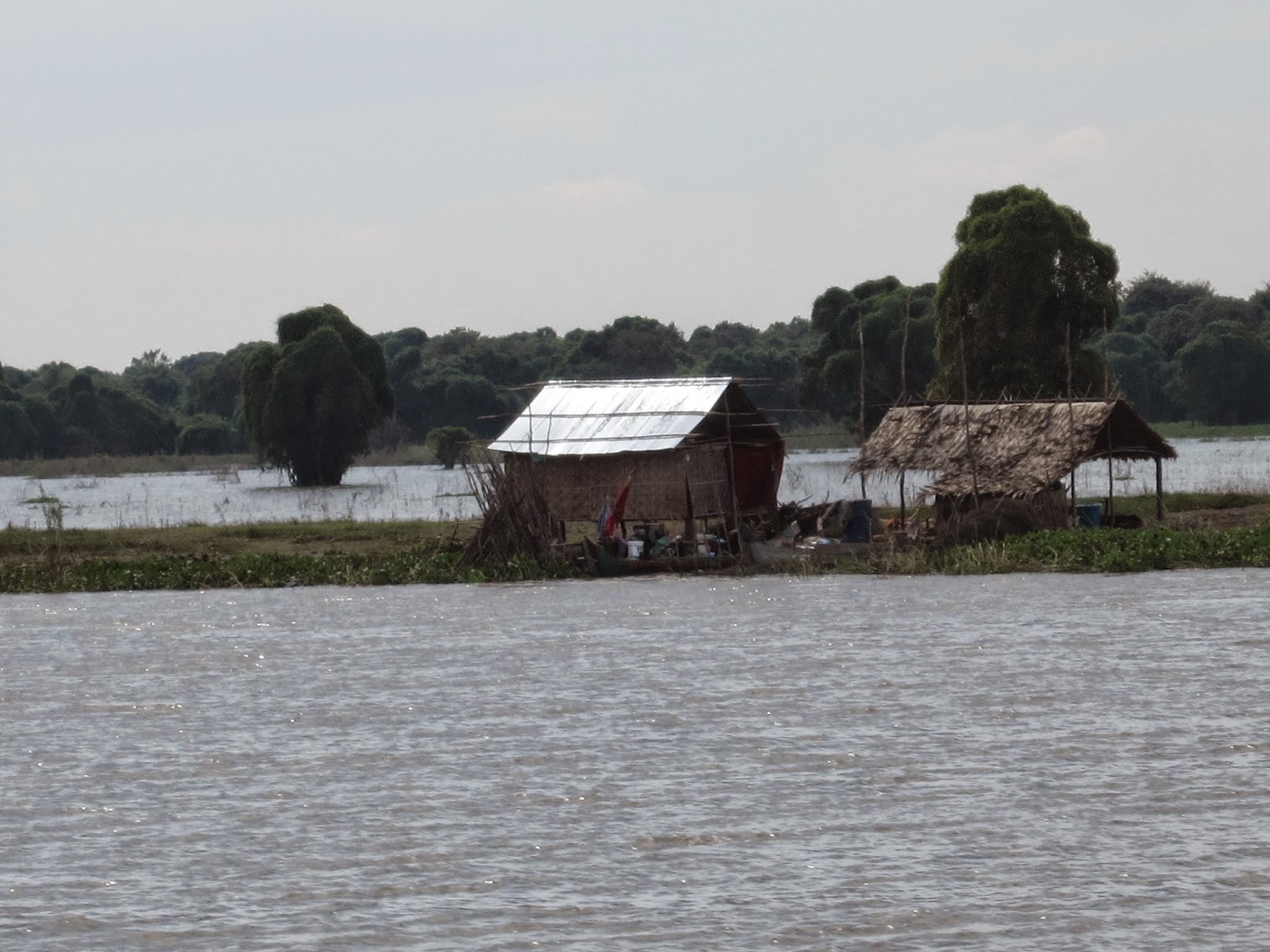
Still, I couldn’t help but be taken in by the natural beauty and picturesque tranquility of the fishing villages that dotted the landscape as my speedboat whirred past. Mangrove forests, floating houses and family fishing boats came to greet us like beacons into another world. This was truly foreign to me–a lifestyle so untouched by modernity, yet so at peace with nature. I admit I felt jealous of them. 
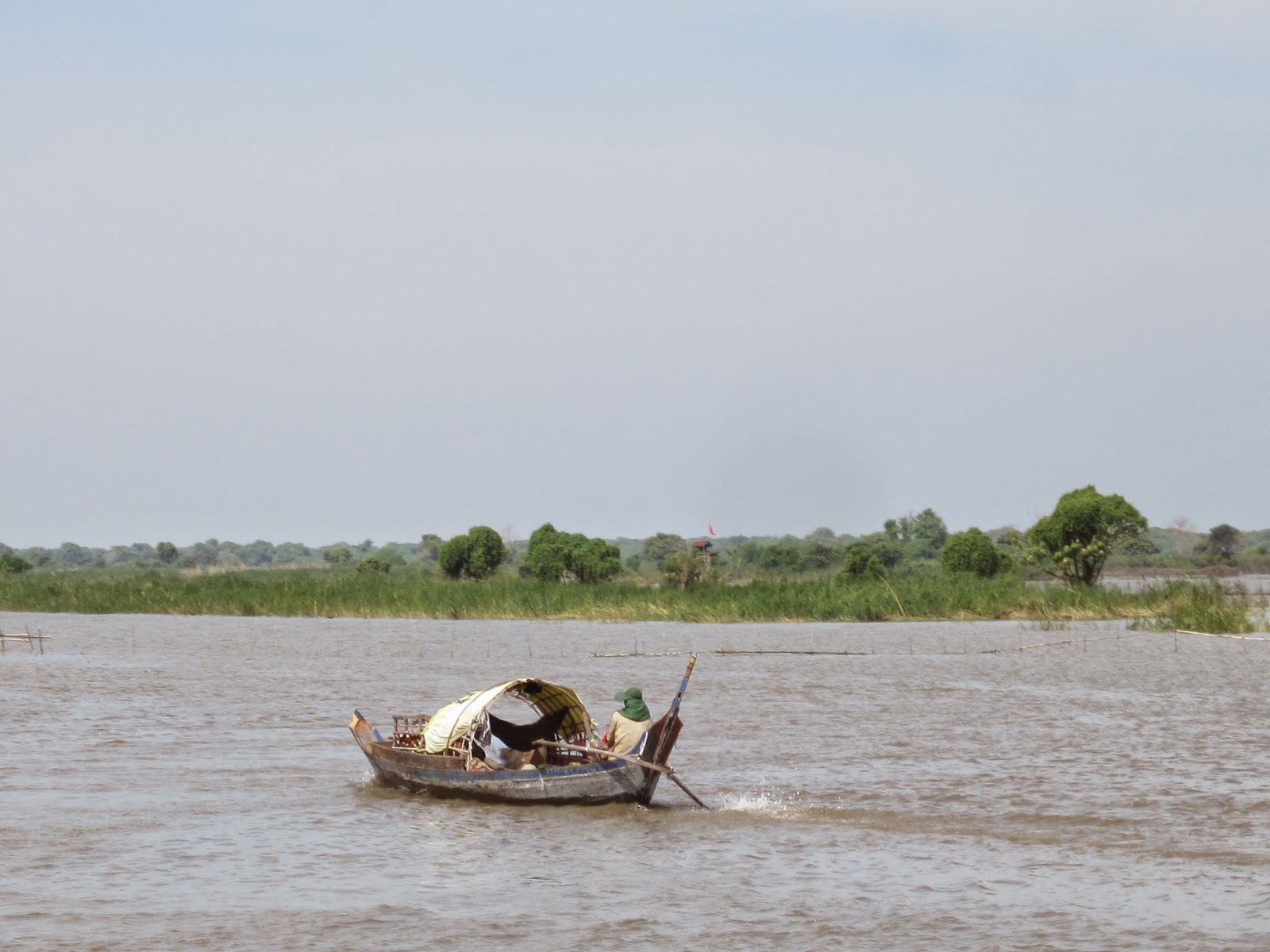
One of many fishing boats we passed. 

Homes built along the water. These are not built on stilts, though most houses are, to protect from floods.

There was something that appealed to me about this lifestyle. And yet I wondered what they thought of me and the other tourists in the boat. As we passed, many of them smiled and waved. I wondered how genuine was this gesture. There’s no way of knowing, though to me it felt truthful. And that, in the midst of everything else, made me feel welcome.

There was one more place I had to visit before I left Cambodia.  I know most people don’t travel for the museums, but I do. Having written a paper on the Cambodian genocide last spring, there was no way I was going to Cambodia without visiting Tuol Sleng, the former prison and interrogation center of the Khmer Rouge.
Tuol Sleng, or S-21 as it is also known, stands in the middle of Phnom Penh, the capital city. From the outside, it is nondescript and seems to blend in with the other beige cement buildings around it. But as soon as I stepped inside I felt chilled. Tuol Sleng used to be a high school; it was built in the sixties during a brief period when Cambodia had a sovereign leader, before the civil war began. When the KR took power, they emptied the city and turned Tuol Sleng into their interrogation headquarters. Here, they imprisoned and tortured thousands of innocent people: members of the opposition government, those with educations, those with glasses, and their families. They also imprisoned a string of westerners here. Their testimonies remain, displayed on the third floor in the original Khmer script for all to see. The kinds of confessions people made up are absurd. The whole thing is absurd. It’s impossible to comprehend.
So I just cried. I cried a lot, and I couldn’t really stop, but I told myself to keep it together, because these stories needs to be told. I felt so grateful to the hard-working men and women who are now running the museum and guiding tourists like me; they have a great responsibility to share these stories. It’s chilling and gruesome to walk through the prison cells, and even worse when you continue on the 15 km journey outside of the city to the Killing Fields, where the mounds dug as mass graves are still deeply imprinted in the earth. I don’t think I had ever been that close to human bones before. It’s a terrible sight. 
So what now? I left Cambodia early; I didn’t want to stay. I confronted reality, and it overwhelmed me, so I left. But for the million and a half that died under the KR, and for millions still living in poverty or under threat of land-mine explosion today, they can’t leave. This is their reality. 
I didn’t stay long enough to ask anyone about it. My tuk-tuk driver, Alex, told me a little about his life as a boy. He is twenty-six years old, and his parents survived the Khmer Rouge. But he didn’t talk about how. He told me how he used to go on the Tonle Sap every day in a boat to fish for extra food to sell at market. He said they were very poor. 
Sympathy, empathy, guilt and a host of other feelings overtook me during my five powerful days in Cambodia. It’s a lot for anyone to stomach, and I try not to shame myself for it, though I wish I had answers and cures. If all I can do right now is to tell this small story to someone else, then I can be happy with that. And maybe you can share this with someone else who may not know about it.  I visited Cambodia, and I found a world that was simultaneously untouched and hopelessly crushed by modernity. It isn’t fair. Cambodia is so beautiful, and I wish I had stayed for a much longer time.

If you’d like to read more about Cambodia’s recent history and to learn about excellent recovery projects like Land-Mine removal, I recommend these sights:
De-mining efforts in Cambodia (this contains information about the Land Mine Museum near Siem Reap, which I also visited. It chronicles the efforts of one former KR child soldier in de-mining Cambodia and helping land-mine victims. Absolutely worth a visit if you are ever in Siem Reap). 

The Traveler and the Wanderer

“All that glitters is not gold. Not all those who wander are lost.”

As a child I recounted these words to myself laying in bed at night, dreaming about climbing mountains and going on big adventures. Most of the time I went on adventure in my head, through the pages of my favorite books. I climbed Mount Doom with Frodo, went to Hogwarts with Harry Potter and rode through Balinor with Ari and her faithful steed. I dreamed of big adventure, but never had the courage to step beyond my own backyard.

Some things may have changed since then, but my propensity towards romanticizing other lands has not. Before coming to Thailand, I had visions dancing through my mind of endless rice fields and pristine white beaches and elephants bathing in the jungle. I know these things to exist in Thailand; I haven’t seen them yet.

I’m beginning to realize there are very big differences between traveling and living abroad. For the next calendar year, my life falls into the latter category. I bought a one way ticket, and I checked suitcases. I spent nearly four hundred dollars on home goods and groceries. I’m not going anywhere anytime soon.

But the linchpin about working abroad is that you are in fact working. You have a schedule, bosses, meetings, homework. I’m not alone and I’m not on my own. And I’m definitely not living in the jungle. In fact, Thailand–specifically Bangkok and environs–seem to be the most built up, sprawling city I’ve ever seen. I have never seen so many malls in so few square miles. And they are massive.

How then can I reconcile my innate longing to find peace outside my own country with my current status? I feel suddenly thrown into a whirlwind of noise and smog and very strong air conditioning. Relaxed though it may be in spirit, Bangkok is definitely not peaceful.


The colorful, chaotic, never ending traffic of Bangkok

I came with the express purpose of learning everything I could about teaching English as a foreign language. But now that I’m here, my wanderlust is growing strong again. I want to explore.


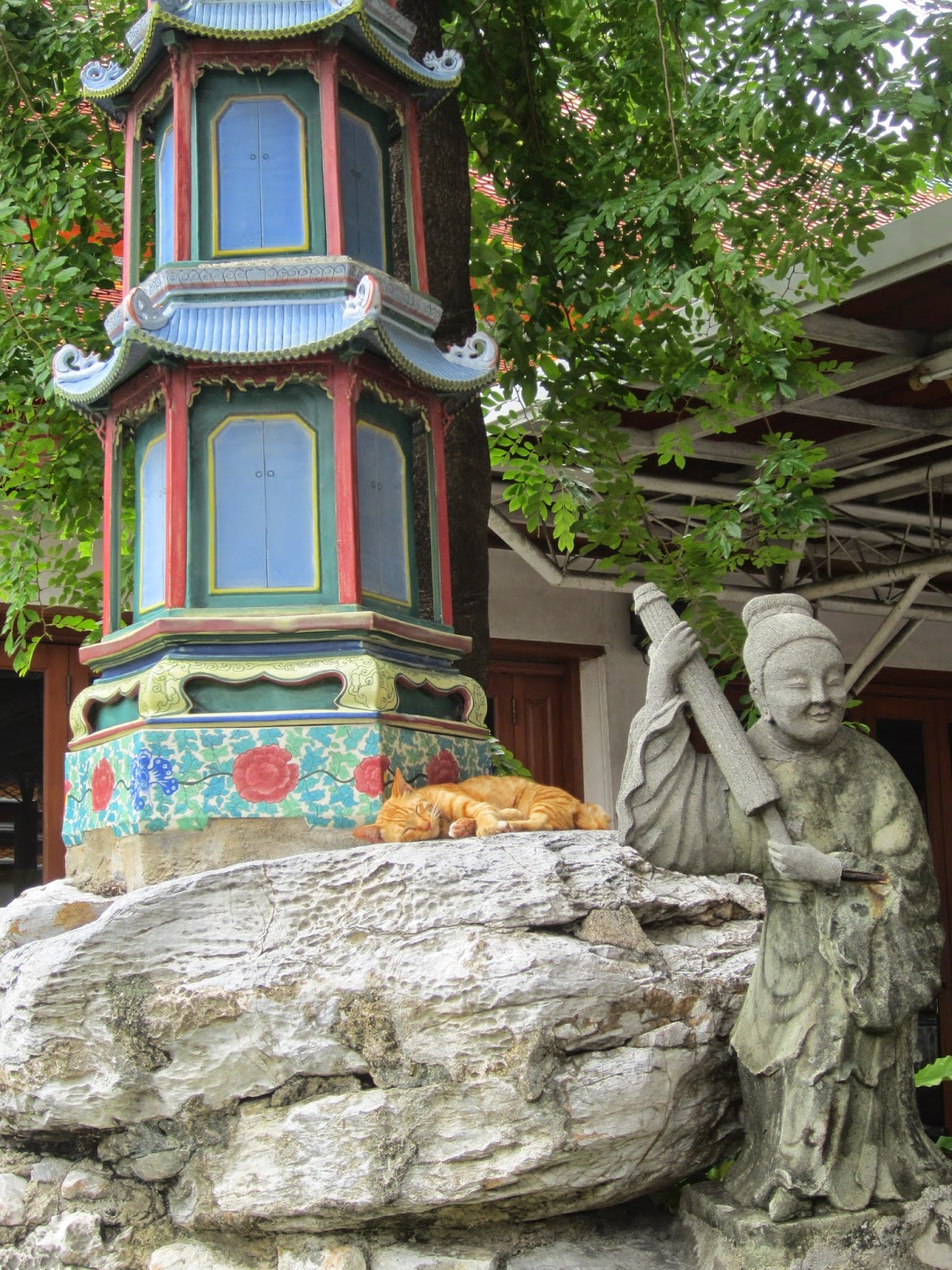
Sleeping kitty in Wat Pho 

I must tell myself I have plenty of time, but there seems to be never enough when one is travelling. But am I still travelling? Regardless of labels, I must prepare myself for the coming weeks. I have so much to learn. This seems to me the perfect opportunity to practice vigilance in planning, both for lessons and travel. I tend to be rather type B when it comes to making plans, unfortunately, which often leaves me stressed out and upset at my own procrastination.

I have a lot to do. Teaching begins on Monday, and I have over 90 names to learn and memorize. It’s going to be a long week, but God willing, it will be wonderful.

“It’s a dangerous business, going out your door. You step onto the road, and if you don’t keep your feet, there’s no knowing where you might be swept off to.”

With love,
Mel

Almost Goodbye–A Mixture of Fear and Optimism

I’m laying on the  box-spring mattress that has been mine for the past month, eating chocolate as I contemplate what my life has been these past four weeks. First, I can say confidently (between bites of Reese’s peanut butter cups–a staple of Artsbridge life) that no other job I’ve had has been as fulfilling as this one. My spirits are high, and despite a little lack of sleep, I’ve never felt better. Tomorrow is the final showcase, the time when the students finally get to exhibit their completed art projects and films to friends, family, and locals (and hopefully a few reporters). Since this is my first year here, I’m not quite sure what to expect, but I imagine it will be an incredibly fulfilling moment for all of them. This presentation is the culmination of their three weeks and their hard work, frustration, tears, and triumphs. They’ve struggled not only with the physical execution of professional creativity, but they’ve had to learn to work in teams with people from very different backgrounds and of largely different opinions. Many of them struggled to have their voices heard and to listen to others, and I’m sure at times they felt like nothing would or could change.

Fast forward three weeks, and they’re now preparing to exhibit professionally crafted pieces to the larger public. But they’re just not displaying their art. They are demonstrating to this community that change is absolutely possible and collaboration can triumph over division. Add to that the fact that some are Israeli Jews and others are Arab, Palestinian, and American, and you have a whole lot of awesome in one place.

This has not been an easy time for the students. There’s a war going on in Gaza. It’s hit us all in
different ways, and they are all struggling to keep their heads in the program. But they’ve done beautifully and come out the stronger for it. I had a small experience with rocket warfare when I was in Israel two years ago, yet I know it’s nothing compared to life growing up in the region. I struggled to place my feelings into the pool when I came here, but I know that this time has helped me grow up and see war in a very different light.  Now more than ever,  the implications of the work here are  immediate and so crucial.

There have been several interviews and articles written about this summer at Artsbridge. Last week we took the students to the Catuit Arts Center in Cape Cod to talk about the program to potential donors. One question that came up and has come up in many of the interviews is, “but does it work?” And, like the brilliant thinkers they are, our students answer with poise and eloquence something that really boils down to “OF COURSE.”

To me the answer is so simple, but I understand why the question is asked so much. “Does it work? Does Artsbridge actually make a difference?” Uh, if you’re expecting us to send the students to the debate tables to arrange a cease fire, the answer is no. Will Artsbridge stop the rockets from firing on both sides? No. Not right now it won’t. But one of the most important ideas we’ve discussed in these past few weeks is the crucial notion that every human being deserves the same respect and opportunities and that individuals have an enormous responsibility to retain their own humanity by recognizing the humanity of others. This means putting love, compassion and empathy before violence, anger and hate. Hate is always an easy way out because it takes humanity out of the equation. To hate something, you have to to trivialize it, make it seem small and insignificant. But in learning to recognize the humanity in each other, our students have chosen to love others rather than hate them. If you love someone, you instinctively want to protect them, to care for them, to support them. I’ve seen an incredible support system develop between these students, who never knew the others existed up until a few months ago. And in the cultural narratives of Israel and Palestine (and in most countries if we’re being honest), it is so easy to forget that human beings exist on both sides of the wall.

So, yeah, duh, Artsbridge makes a huge difference. It gives young people the tools to go back into their communities having understood what the view looks like from the other side, having spoken and laughed and cried and danced and swam and played and created with human beings from the “other” side, humans whom they didn’t know existed. Abstract concepts about “groups” and “identities” have hopefully been replaced with concrete faces, voices, and unique personalities that have bonded and  will never be forgotten. And I think they’ve all found that they’re not so different after all.

An Update: Change is Work and Work Takes Time

Change is work, and work takes time. I’ve been in Williamstown, Massachusetts for a week and a few days now. I came to be a counselor at a program called Artsbridge, Inc., which was set up about eight years ago. Every summer, a group of talented and compassionate artists and educators take a group of approximately thirty students from Israel, Palestine, and the United States to an area of Massachusetts, away from the fires of home for three weeks of intensive dialogue sessions and art projects. The kids arrived here at the Buxton School in Williamstown four days ago, yet it already feels like three years since they’ve arrived. Energetic doesn’t begin to describe this group. They came like hurricanes, bearing the force of their personalities and experiences with exuberance and spirit. I’m honored to be a part of this project.

What I’ve experienced so far has been a whirlwind. Things are beginning to “slow down” in the sense that now, finally, after the staff and students are all adjusted and (marginally) well-rested, we can begin the work: the intensive dialogue and group art projects that will challenge the students to their very core–and the staff as well–to think about the “other’s” point of view. Opinions change, and things are fluid when it comes to self and relationships. It is here in this setting where art can thrive and truly work its wonder.

One of the reasons I was drawn to the program was that it embodied everything I knew art to be but never experienced for myself. In this program, art is not only a means of expression, but a vehicle for discussion, for opening up channels of one’s self and self awareness that can lead to new discoveries, relationships, and revelations. Arts tell stories, and we all have our own story to tell. I can’t wait to see what the students produce.

I broke down after the first twenty-four hours of being here (thankfully before the students arrived). I felt like a part of myself–a very big part–had been shut down for years as I bulldozed my way through school, eking out papers and bullshit thoughts about taverns in Potosi and communism in Eastern Europe. Okay, maybe it wasn’t all bullshit. I love history, and I love thought, so in a way I suppose I found college stimulating and enriching. But on the flip side, I became so disconnected from myself that I forgot what joy was. I shut that part of me down–the part of me that loves to sing and dance and smile and laugh and soak up sunshine. I put that part of myself on a shelf and told myself that I was here to work. So I did.

I cried a lot in college, which isn’t really saying much, because I cry all the time. But I became very sad in a way that I hadn’t been in years. Why? I couldn’t understand. I couldn’t rationalize it. I had been given everything that I thought was important to me–a top notch education, a means to a career and a life of “success” in any profession I chose, a loving family who supported me, an on-campus apartment…even my meals were prepared for me. I had nothing to do. I had no reason to engage with the world.

So I didn’t. I spent days–days–in the library, in the horribly dark and depressing basement, watching movies (for school, really), reading (sometimes very dry) articles about any sort of “ism” you can think of. I chewed on words and spat them back out in paragraphs and pages. And at the end of almost every day, I walked back to my apartment, exhausted, depressed, and alone.

Maybe I’m being a bit extreme. It wasn’t all horrible. But even fun felt forced, because I had this constant weight on my chest that I was missing a deadline or missing a connection and wouldn’t be approved of. This is why I can’t do grad school right now. I need to remove the cinderblock from my chest and breathe.
Still, Artsbridge is definitely not a walk in the park. It is challenging me in so many ways that school never did. I can’t ever escape if things get tough, and escape has always been my go-to mechanism. But I wonder if, during my escapes, I was ever processing anything. No, I don’t think so. I think I just shut down.

This is what teenagers (and some adults) do; if something is difficult, you go to sleep, go on facebook, go to the library…shut down. Overload. Done. And sometimes we need to shut ourselves off so that we don’t implode. But we never deal with what is in front of us if we don’t, well, stay and deal.

My impulse has always been to run away. Now I feel like I want to run to something. I ran to Artsbridge, and once I arrived, I couldn’t believe I was here. I felt confused, consumed, and alien. I suppose this is natural. I think it is. But I’ve always wondered about people who stay–why is it that they can bear the brunt of things that make me cringe and cry? For many people, it’s not a choice. For the students of Artsbridge, they don’t have the opportunity to run away. Home is a battlefield. In my own experience, I can’t begin to understand this.

I’m struggling to conclude this posting, probably because Artsbridge is only beginning, and I know my experiences will change how I feel. I’m so excited for what is to come, and I feel more prepared than I’ve ever been. This is not to say that any of this will be easy, but life isn’t easy. It’s messy and horribly broken. There’s a Jewish concept called “tikkun olam,” which means “repairing the world.” There’s a similar concept in Christianity: “go and make disciples of all nations”–not by force, and not by might, but by building relationships with others, as did Christ, for whom “their is neither Jew nor Greek, neither slave nor free.” I’m learning that discipleship doesn’t mean force or change. It means meeting people where they are, and staying with them to talk about their lives. It doesn’t mean “correct” or “incorrect.” It means understanding. This is the discipleship I want to live, and in a scary way, I feel that I’ve come to the right place–not to talk about religion, but to break down barriers and realize we are all exactly the same in this world.

I realize this is a self-centered blog today. I’m hoping that eventually I can stop posting about myself and write about my observations from an unbiased perspective. But that’s why I’m not a journalist…not yet, anyway. I love you all, dear family and my friends who I hope are reading this and thinking about me, because I’m thinking about you, and I love you all very, very much.

With love,
Mel

PS–If you want to learn more about this amazing program, please visit www.artsbridgeinstitute.org. You will be amazed.