Juggling

Written February 20.


College is very strange; it’s a microcosm of emotions in extremity. It’s a fishbowl, overflowing with bubbles and water and plastic jewels.


I moved on campus. As a second semester senior, I moved on campus. I never do anything in the prescribed order. I think I’m physically incapable of normalcy. This isn’t a good thing.

I met wonderful, beautiful, truly lovely people. I love them and I think they love me, and I am very, very happy. Truly happy.

I’m still restless and a little bit sad. I think I will always be a little bid sad? Maybe I’m in mourning.

I’m mourning for the world? What did the world ever do for me?

Nothing. The world is a broken place. That’s why we are only here for a short amount of time. We won’t live forever, not here. (But God gave me life. I am here out of love.)

Where will we go? I wish I knew. I’ve made a lot of guesses in my life, but no one will ever know.

Somehow knowing that we’re only here temporarily liberates me to be free and to try without recourse or fear or failure; because, after all, what is failure but the opportunity to fail again, better? 

Samuel Beckett said that–or something like it. Dr. Cornell West quoted that today, at my school–a school I have become very proud of since moving here and realizing that ideas are made and grow swimming around inside fishbowls until they get so big they burst out and rain down on the coffee table.


True, ideas come from people and people are still human. But what does it mean to be human? Does it mean to accept our flaws, our sins, accept Jesus and accept our brokenness?

When we do that, what then? When we accept our flaws, our sins and our brokenness, where can we go from there? Can that acceptance liberate us?

Acceptance can liberate a lot of things. Acceptance can make us free to pick up the pieces when we fall down, to fall better, to fall more. Falling, failing, flawing, flying, floating, fleeing, seeing and being human. 

I was amazed tonight at a juggling performance. The juggling was mesmerizing; so was gravity, drawing balls and pins toward the ground, banging the earth, bouncing back into the boy’s hand as he picked up the balls he dropped and threw them again into the air, juggling, two, three, four balls and pins and circular things. He dropped them, they dropped him, he picked them up and threw them around again and the falling became part of the dance.


May you always keep falling, keep flying, keep running, keep, keep, keep falling and dancing, flailing and flawing, being human. 

Growing Up

One day when I was in Israel and the war was going on, my friend Sarah told me of a friend she had had in the army. Her friend had said to her once,  “Why am I here? Why am I learning about guns and military operations? I should be learning art, romance, opera, love.”

I turned to Sarah and I said, “I came here because I told myself, ‘Why am I not here? I am wasting my time studying art, romance, opera and love. I should be studying politics, military operations, guns.”

I wanted to understand the world.

But does this mean understanding guns?

Can you really ever understand guns?


I fear I’ve been judging reality and approaching life in a horrifically naive fashion. Because truth be told, people are just overgrown children with guns. There’s no secret that justifies war, ever. 


It’s symptomatic of studying the Holocaust. At a certain point, horrific details begin to become normal because you’ve become accustomed to the descriptions.

But these things are not normal. Not normal for a world that was created by God out of love. Not normal, ever.

Perhaps my existential crisis was brought on by, in addition to having spent the last six hours in the library, a poetry workshop I had the crazy pleasure of attending last week. The workshop, to my unraveling, encouraged word diarrhea, which is never welcome in military situations, nor in–let’s face it–some academic settings I’ve found myself in lately.

The funny thing is, we were specifically instructed not to talk about abstract concepts like war or poverty. Yet of course I did, because I’m slightly sadistic and moody. So, under a list of “Things I Know to Be True,” I wrote this:

4. War is never justified, but it is always justified until someone renames the war as something like “an operation” [which they did when I was in Israel] or “experiment” [like German medical experiments..]. That’s how you know that the person renaming the war is just as scared as the people running away from missiles. I know this because I ran away from missiles last year. They were small and wimpy, but no one appreciates blocks of metal raining from the sky. Maybe the only thing worse than hiding from a rocket in a cement underground is lying on your belly in a moving train with sirens blaring in the background tell you you may not live to see your sister step off the plain in Tel Aviv.

My handwriting had grown messier by this point and I admit my heart was pumping a little bit faster. This was when my instructors said “stop.”

This was why I thought I should understand politics, because maybe I could tell people that war is bad. But surely other people know that too?

They do, yes, they do. I’ll bet both arms the thousands of people afflicted every second by civil war know that it’s bad. It doesn’t take an education or a fancy suit to know right from wrong, but it does take a little bit of courage.

Maybe I’m being melodramatic and extremely selfish. Here I sit, safe at home in suburbia, tucked away from harm with a blanket of freshly fallen snow waiting for me outside. Yet I’m beginning to feel restless again.

“Not all those who wander are lost.”

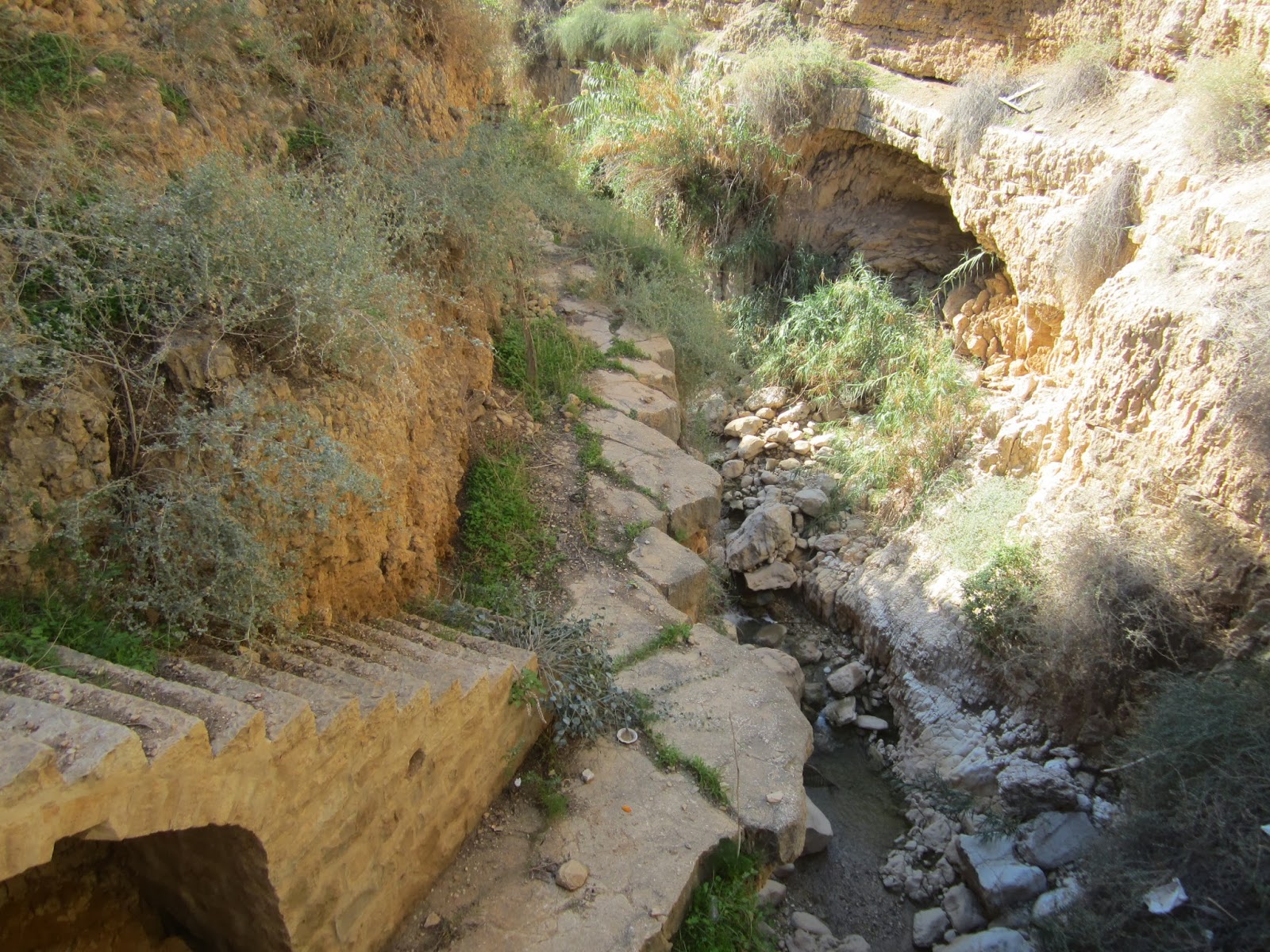
A small river flows beneath a sixth century (?) Greek Orthodox monastery
 in the mountain deep of a desert expanse separating Israel from Jericho in Palestine.


The Art of Calm (A trip to Kentucky)

Kentucky is a beautiful state. I never appreciated this growing up, because (and I honestly have no idea where this came from) I had a deeply-seeded resentment of anything south of the Mason-Dixon line. Still, late fall, stress from school and eventual early adulthood brings with it dreams of hibernation, home and pie. Being able to  spend all day in pajamas is also high on my list these days. So after coming back to Memphis to visit my family for fall break, we took a road trip to Kentucky. The entire drive, I stared out the window, slightly out of breath over the forgotten beauty of so many rolling green hills. It seems I’ve developed some kind of armor to protect me from life in the northeast and, in the process, I have neglected to look up at the sky. Like Icarus, I flew too close to the sun. It takes coming home to realize you never needed wings in the first place.

I won’t pretend I’m a sophisticated northerner. I speak more slowly than many people I know; I don’t own any Ray-Bands or black high heels or know all the subway lines in Manhattan. Still, I’m noticing some stark differences between the vast, expansive south and the busy, densely populous northeast. For one, in the drive from Memphis to Kentucky, I saw more trees than people. More trees, more leaves on the trees, more blades of grass, more fish in the lakes, even more clouds in the sky. There is somehow more sky.

When the only thing you have to contest your existence against is something that’s existed for hundred of years, like a tree, you suddenly feel very, very small. It’s almost impossible  be existential in a city! There are too many people telling you you’re wonderful, and not enough reminding you that the trees were here first.

Also down south, people…are just so friendly. I always thought this was a myth, that people in the south are friendlier than in the north. “Just because people down south smile and wave and say ‘hello’ as if they mean it doesn’t make them more friendly.” Perhaps I will test this some time and see how long I can talk to a stranger in Memphis or Bowling-Green before he or she gets bored or scared of me. But at least when people greet me with a boisterous “hello,” I know they really mean it. You know that awkward semi-acknowledgement of a stranger’s presence, where you’re too shy and too busy to be genuinely interested in someone else’s day, but you don’t want that person to think a bad thought about you so you smile and eek out a timid “hi,” and the other person blurts out, “Hihow’sitgoin’?” and then just keeps walking? Yeah. In the south, strangers greet strangers with genuineness. And they separate their words.

Perhaps what I’m experiencing is a bit of rose colored glasses syndrome, that feeling you get when you’re in a new place, when you’re exhausted from what you’ve left behind, and you look at your present surroundings with admiration and bliss. To tell the truth, I never thought so rosily about the south when I lived there.

In fact, all I remember dreaming of (aside from other planets) was my fantasized, grown up life in New York City. So perhaps now as a young adult, I’ve begun to reverse the fantasy and trade skyscrapers for landscapes and subway lines for tractors. Or haystacks…

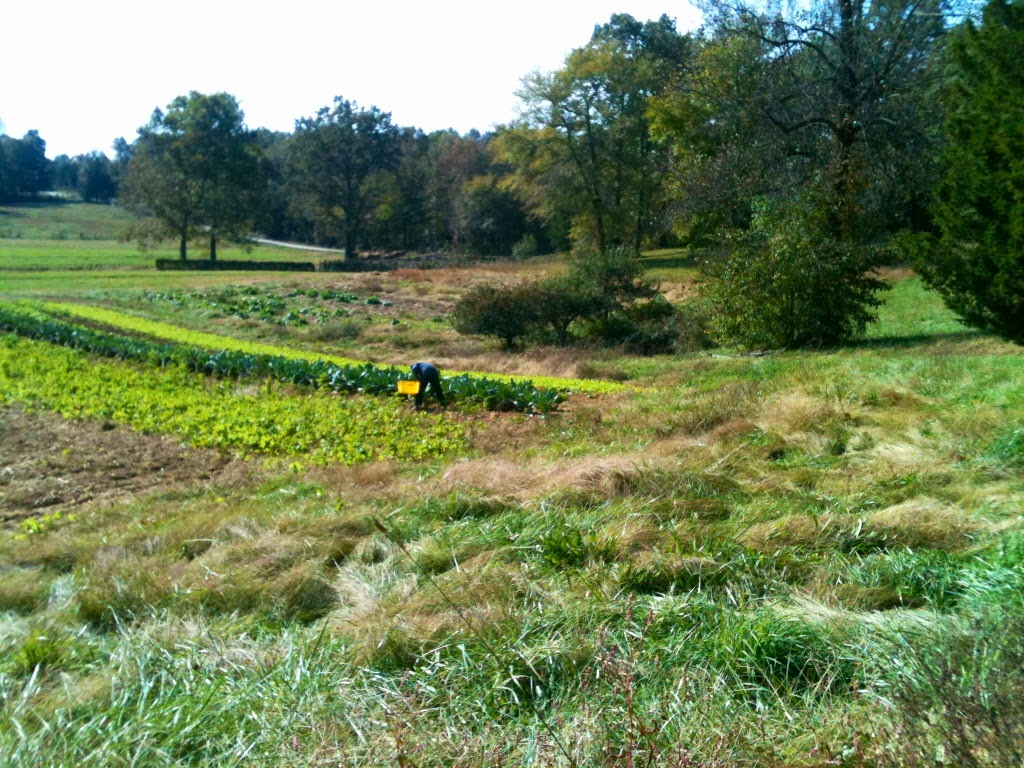
Our time in Kentucky was full of farms, animals, fresh air and Mennonites markets. I overheard the boy pictured at left (click to see the detail) speaking Dutch with his father, owner of the first Mennonite farm we visited, where my own father proceeded to buy over a hundred dollars worth of squash! Seriously.

I watched this boy, about ten, grab a basket and pluck a few leaves of kale from the stalk and then mosey on back up to his house, to sell it or to eat it.

I admit I was jealous. When I want to cook kale, I need a car, a shopper of the month card, cash, car keys, a wallet, and the patience to walk under halogen lights and stand in line at a conveyor belt while trying to ignore all the celebrity gossip and “HOW TO LOSE TWENTY POUNDS IN TWO DAYS!” advertisements.
.
Perhaps this trip was exactly what I needed. Blue skies and sunshine. Apple pie, baseball games, harmonicas and dogs on my lap. I had no idea I was so…American.

“Country rooooad, take me hoooome, to the place I beloooong!”


"For great is your reward in Heaven."

“The problem is that we have come to redefine humanity as something autonomous, independent and individual, where our own wills are paramount. But we were given free will so that we might choose love by choosing God, because love cannot be true if it is not free. God does not control us as puppets.”

I sit across from the parish priest thinking, Where was this when I was growing up? We talk of Revelations, the end of the world, when “God will unite Heaven and earth, and all of creation will join in eternal revelry.” The end of all ages. “We are in the seventh and last age of this world,” he tells me calmly, “And Christ will return at the end of this age.”

Where was this when I was growing up?

Where is this now?

I sit in the body of the Church, on a wooden chair opposite the Father who, with his white hair, resembles something of a sage, or at least this is the image I have come to associate with spiritual wisdom–white hair, bushy beard, warm yet quiet eyes, somehow alert yet distant.

I sit in awe of the alacrity with which he answers my questions, vain and complex as they are.

“I feel that, if I can’t be perfect in the eyes of God, there’s no point in trying.”

“No, no! Danger Will Robinson!” chuckles Father. “No one is perfect except Christ.”

Oh, right. I forgot.

In the Gospel of Matthew, Christ says “You are the salt of the earth, but if the salt loses its flavor, how shall it be seasoned?” Similarly, a a few verses later he says:

You are the light of the world. A city that is set on a hill cannot be hidden. 

A city on a hill, like, a Church?

Nor do they light a lamp and put it under a basket, but on a lamp stand, and it gives light to all who are in the house.

And in case the crowd wasn’t too keen on metaphors, he continues:

Let your light so shine before men, that they may see your good works and glorify your Father in heaven.

You are the salt of the earth. You are the light of the world. If you were wondering what was the meaning of life, this is it.

All these thoughts ran through my head as I spoke with Father. My eyes wandered to the new icon of St. Seraphim of Sarov, who sits clothed in white robes feeding rabbits and bears amid tall pine trees. Snow White wasn’t the only one with an affinity for forest creatures.

“Sometimes I feel like I can’t do everything I want to do in life and be a Christian.”

I said this to a friend earlier. “I feel that every day,” she responded.

The truth is, I’ve failed, terribly. I judge people, and I judge the Church for hiding from the world, when really I should be judging myself, because sometimes all I want to do is run away, run away from the world, run away from its challenges, run away from the awkwardness of meeting someone and not knowing what to say, run away from the insecurity of thinking that I’m worthless in this person’s eyes, run away from the blatant reality that I am not perfect and no one else is either. I go out into the world, and I get knocked down every time, because it turns out that the world really is full of evil.

Sitting in the Church sanctuary, my soul is at peace and my burden eases off my shoulders, which makes so much sense when I remember the words “come all ye heavy laden and I will give you rest.” I hope this happens for all those who come, and I believe it does, which is why people return to Church every week. But then, sometimes we don’t go to Church. And while it seems to me that this absence makes our burdens weightier, what about all the millions of people who don’t even know this Church exists, or who can’t come because of physical ailments, or financial constraints, or hardened hearts, or stubborn wills?

Every day I feel like I live in two separate worlds. The first is my school world, the world of pseudo-academia, where I’m taught to deconstruct texts, avoid positivism, challenge the hegemonic worldview, and critique all authors. There is some truth to this; the American historical perspective suffers from severe positivism and from the little I’ve read it’s clear that the world is NOT progressing along a straight line. Not only is this theologically incorrect, but it’s historical fallacy.

But there are several modes of thinking that disturb me in this world. The first is the all-or-nothing dynamism that essentially strips away academia from its core, which (should be) the search for truth: “If anything is true, then nothing is true” and “If everything is correct, then nothing is correct” and so on. Or even worse, “truth is relative.” Or, to go back to quote Doestoevsky “Everything is permitted.”

Sometimes I really do think that if we all read the Brothers Karamazov, the world would solve all its own problems.

But that’s not the case. And how can truth be relative if Truth is Christ?

But not many people know Christ. I don’t. Not in the way that I should. And who am I to tell anyone else what he or she should know or believe? It’s not my place.  I’ll give a mostly unrelated example: I tutor a few freshman students, some of whom are reluctant to study, and one in particular doesn’t go to class. If this student continues to skip class, the student will fail. If the student fails, the student might not be allowed to continue in school. A leads to B leads to C. This is the direct consequence of an ill-conceived action. It is certainly not the desired outcome, but the outcome has potential all the same. Is it my place to tell this to my student? “If you don’t do your work, you could fail. And if you fail, you could lose your scholarship and have to drop out of school.” That’s not tough love–that’s reality.

The student could, however, and I predict, will refute my seemingly logical argument, by saying that grades are relative (which seems not too far from the truth anymore) or that she can charm her way into getting to keep her scholarship.

Has the student, then, lived with integrity? No. Has she gotten what she wanted? Yes, for now. Could I have saved her from this potentially humiliating feat if I had forced her to do her work? Possibly. Would she have learned how to do the work? Most likely not. What, then, was the point? Was I of any help at all? It doesn’t feel like it, since I am a horrifically result-oriented person. If I can’t see the positive outcome of something I did, I feel like a failure.

Imagine how Christ’s disciples felt. Do you think they were feeling like they were changing the world when they watched their beloved Teacher being hoisted onto a wooden plank and stabbed with nails for all the world to mock?

Hardly.

This leads me to my second world, the world of modern Orthodox Christianity, which sometimes seems as terribly backwards as deconstructionism seems awkwardly futuristic.

I thought that Faith was about me–about my journey towards Heaven. Like Pilgrim, I painstakingly record in my brain all my faults, defeats, cedes to temptation, and failure to follow doctrinal rules; I fall off the ladder, cry, and struggle to get back on. Life is a journey, so people say. And what actually is the point if I know I’m not perfect and will continue to fail and sin?

I’m not a theologian. I’m not a Divinity student. I don’t even have my bachelor’s degree yet.

But I am a Christian, however terrible I am at that, and I want to continue to live a Christian life. But that’s the thing–I have to continue to live. 

I can’t sit in a dark corner waiting for Christ to return. And I don’t need to. I’m not hiding from the Romans, and I know my Lord is Alive. Frankly, when the world reaches its end, it will end. I think the sheer fact that the world still turns this very moment means that there is work to do in God’s creation.

The world is the result of God’s love, and mankind is that manifestation. Frankly, the Gospel’s couldn’t be any clearer if they tried. Well, obviously..they’re the word of GOD.

You are the salt of the earth; but if the salt loses its flavor, how shall it be seasoned It is then good for nothing but to be thrown out and trampled underfoot by men. You are the light of the world. A city that is set on a hill cannot be hidden. Nor do they light a lamp and put it under a basket, but on a lampstand, and it gives light to all who are in the house. Let your light so shine before men, that they may see your good works and glorify your Father in heaven. 

Here’s the conflict: Do I hide in a false church of pretend perfectionism and chastise the world for evil, or do I fall away from false dynamism–in the secular and canonical worlds alike–and try my hardest to live according to the Gospels’ teachings?

It sounds a bit renegade, I know. But then, so were the Apostles. Not that I want to evangelize–an Orthodox priest told me once that we should evangelize not with words or doctrines but by living exemplary lives. That’s a lot of pressure. But that is the point.