If you’ve ever thought that spending time in nature sounded nice, have you checked out WWOOF?
WWOOF stands for World Wide Opportunities on Organic Farms, and is exactly what the name says. It is an international network of organic farmers, who serve as hosts for eager travelers. It’s a chance to explore a different region/country/continent, practice some language, learn a skill, and develop amazing relationships you’d never expect.
I spent the last two weeks of my spring Eurotrip WWOOFing (yes, it’s a verb) in Basse-Normandy, France.
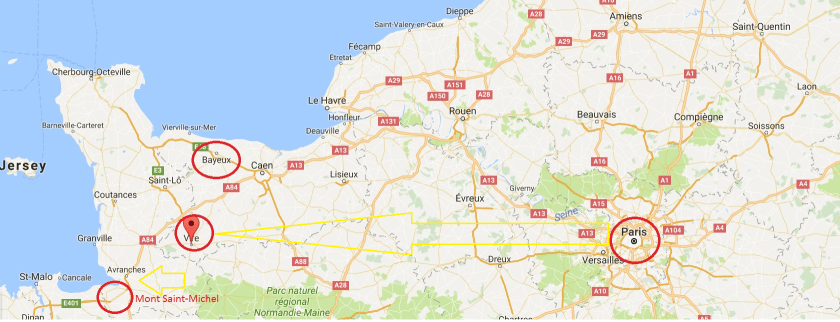
A map of my route, for reference!
How did I choose a tiny town in Basse-Normandie? Simple. On the WWOOF website (you pay 20 Euro be a member for a year and then you have access to the catalogue of host farms in the country you choose) there is a list of filters including type of activity (IE permaculture, orchard, dairy, eco projects) and length of stay (one week, two weeks, 1 month). I had two weeks to farm; I was interested in orchards and eco projects. So I found La Fermette du Bellefontaine.
A rainy day on La Fermette
La fermette means “little farm,” and that’s exactly what it was: a small scale organic farm owned and operated by a few friends. Each had his and her own plot of land and primary source of income: one is a vegetable gardener, one a seamstress, and my host, the master baker.
For most French people, bread is life. It’s fresh, it’s inexpensive and it’s eaten three times a day. And why wouldn’t you eat it when the grain was grown and harvested three miles away?
As for eco projects, these included a composting toilet (of which I sadly did not take a picture, but I’ll leave that to you to research), an organic sewage system that uses water-loving plants to clean used water, and newspaper insulation. All created by my host out of his desire to “be as autonomous as possible.”
It’s amazing what you can learn when you least expect it, when you enter into a new situation with zero expectations. I left a lot more informed about steps I can take as an individual to reduce my impact and respect our planet. And I had the best cheese of my life.
View of the town from a hilltop! Not pictured: the medieval fortress I climbed to take this photo.
I fell in love with Prague five years ago on my first trip to Europe. The moment I stepped on to the Charles Bridge, I felt home. I also contemplated moving there and supporting myself by singing opera on the famous bridge for money. I even wrote a set list. But while my chanson dreams might be on hold for the time being, I was overjoyed to find Prague’s charm and romance no less palpable on my second visit, and I have a feeling I will never stop returning to Prague.
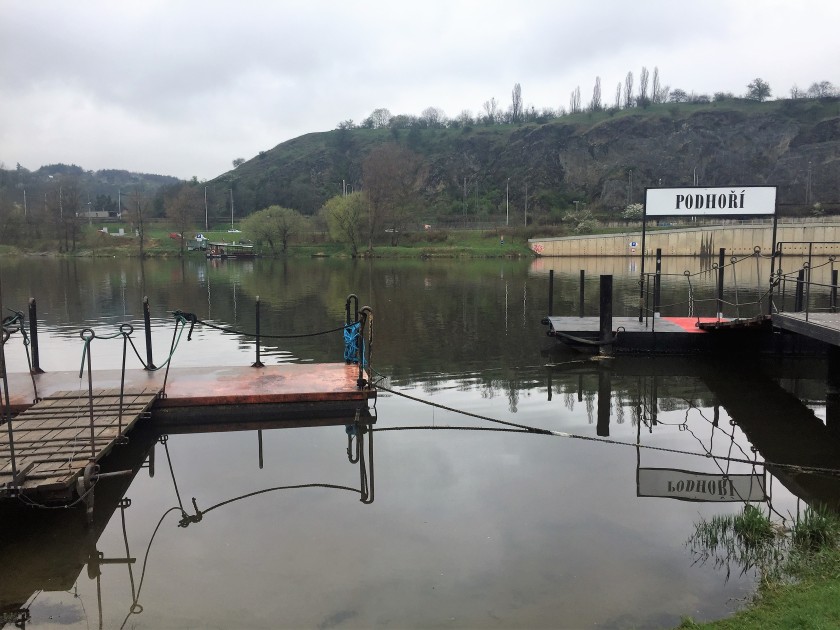
On the outskirts of Prague, waiting for our boat taxi to take us across the Vlatlava…
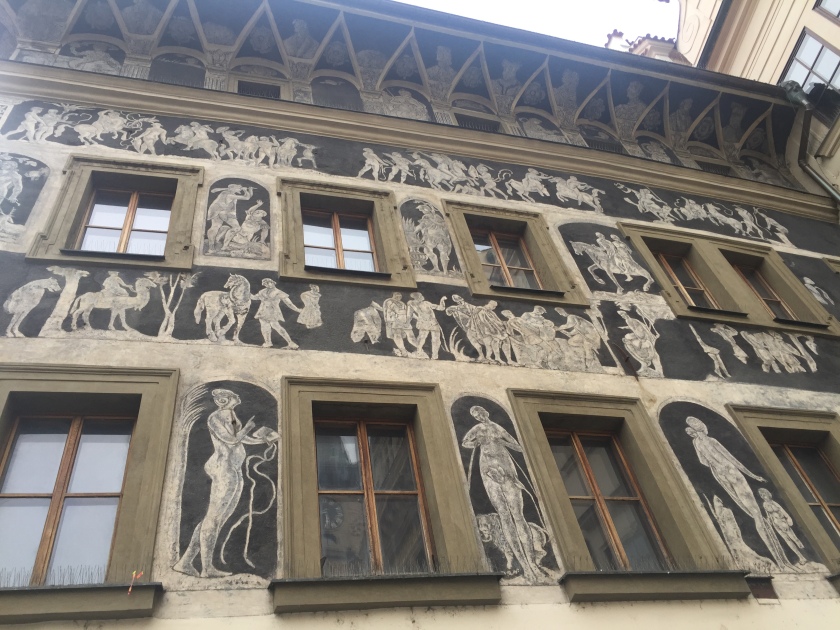
Prague has an ancient history, and some of its oldest standing buildings date back to the 14th century, when King Charles IV, ruler of Bohemia and later the Holy Roman Empire (which included all of Germany, Switzerland, Belgium and the Netherlands, most of the Czech Republic and parts of Austria, Poland, Italy, and France) established the first university in Prague (King Charles University). It’s no big deal to walk around a neighborhood in downtown and see modern trams running next to gothic cathedrals and art-noveau buildings. This is the flavor of Bohemia!
Of course, there are also a few modern additions, including the infamous TV tower, notoriously hated by Czech people, which was built under communism. The building might be an eyesore, but it offers some of the best views of the city. We rode to the top of the tower and had a 360 degree view of all of Prague’s architectural wonders:
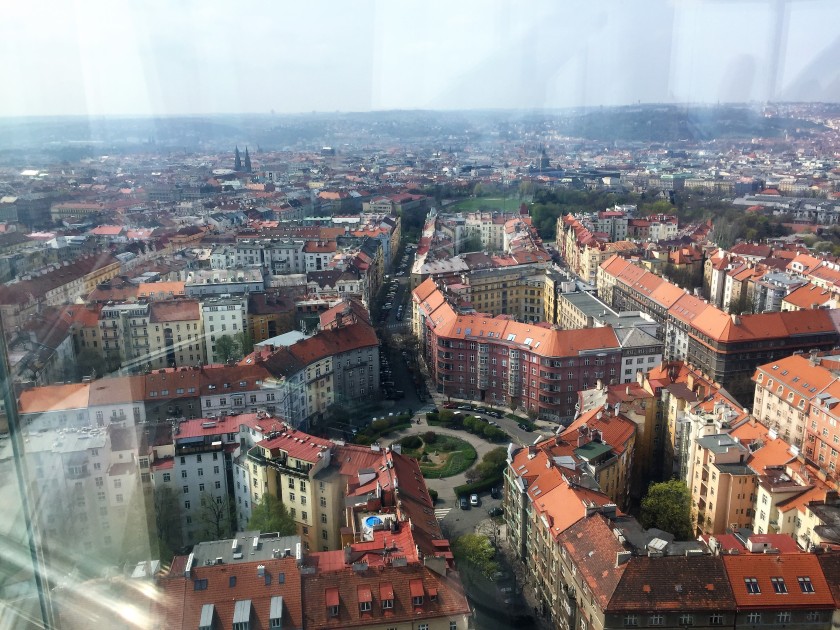
View of Zizkov neighborhood from the Prague TV tower. The slanted, red brick roof are a signature style of the city; in the distance you can see Gothic spires peeking up to say hello!
In Old Town Square (Staroměstské náměstí), one can find the famous astrological clock (which parades a collection of dancing marionettes every hour on the hour…think “world’s biggest coo-coo clock”), as well as several churches, a memorial to Jan Hus (Protestant reformer), and this hidden gem inside the old City Hall, the Skautsky Institut (Scout Institute, non-profit and community organization for youth. If you’re there, you should visit their café inside the building on the second floor. It reminded me of several funky coffee shops in Memphis, only a bit smaller.
A side view of the very old City Hall building, which is now owned by the city and rented out to the Skautsky Institut and other organizations.
No trip to Prague would be complete without a visit to the famous Prague castle, which is a huge compound that includes the Gothic St. Vitus Cathedral, beautiful Baroque-style gardens, and several ancient halls where kings of old were crowned and celebrated and some unpopular nobles were pushed out of windows. The castle stands on a hill top, and its spires are visible for miles. The area also offers some of the most picturesque views of the city, like the ones below. On the left is from this trip (our weather was less than ideal, but c’est la vie). On the right is from five years ago. There’s a bit more sunshine and fewer trees, but it’s still the same skyline!
a view of Prague’s skyline last week
a view of Prague’s skyline on my first trip, five years ago
When you visit the Castle, I highly recommend a guide and a comprehensive admissions ticket. I didn’t do this last time, but I am so glad I did on this trip. It is a bit pricey for Prague ($14 USD), but the ticket gets you inside of the Cathedral, the old hall, All Saints Church, and the Golden Lane, which is a small, cobblestone street with museums and displays about Prague in the High Medieval era. All in all, you get an a lot of insight into Prauge’s complex history. Bonus: It also includes a visit to the dungeon and a few dozen rusty torture instruments on display (Game of Thrones, anyone?).
The interior of St. Vitus Cathedral
an example of the stained glass inside the cathedral
benches for worshipping; in the background stands the tomb of one of many Medieval kings burried here
the southern exterior of the Cathedral
The second visit was even better than the first. This was largely due to the gracious hospitality of our friend, host, and tour guide, whom I had met five years ago while studying in Israel. She took us to some truly remarkable places that were tucked away inside cobblestone lanes, including a hip vegetarian restaurant called Lehka Hlava (which means “Clear Head” and runs only on reservations) and a wonderful little wine bar dedicated to St. Agneska (Agnes), who founded a small monastery nearby in the 13th century, before Gothic spires had taken over Europe. We all decided that this place, called simply Agnes, serves the best hot wine in Prague. The key is to add raisins soaked in rum, and serve it with a spoon for fishing out these delicacies.
I heard from my friend that the owners of this wine bar are ready to retire. They want someone to take over and continue serving wine and snacks to locals for the next few decades. My friend is too busy, but who knows? Maybe I can work there when people get tired of hearing my rendition of Ave Maria on the Charles Bridge…
6: oh yeah, the first week of Lent…clean week…the week that’s supposed to be all about God
How many times have I forgotten that?
I know there are lots of non-Lent people out there. The simplest way I can explain Lent is that it is an opportunity for life to finally be not all about me. Because I am always acting in my own self-interest. Even when I make to-do lists and bucket lists and packing lists, those lists are serving my own self-interest. Lent comes at a time when life is starting over, trees begin to bloom again, and we force our bodies into social exile. Why? Because Christ did it first, for us. This is our opportunity to tune everything else out and tune in to Christ.
I wasn’t looking forward to Lent until recently. I’ve been on a roller coaster with my faith, I admit plainly, and so I was looking forward to Lent as a way to level the spiritual playing field, so to speak. But then I wiped out on my bicycle and landed in the hospital. This was Monday. Thank God I’m okay, and I do mean thank God. And my guardian angel. And helmets.
Today is Thursday. I walked outside for the first time since Monday afternoon, and I got so excited about it that I left the front door open and my dog snuck out. Here I was thinking things were getting easier but nah, that’s not real life.
Fortunately my dog came back. But the lessons never cease. There will always be something going wrong…and that’s the thing I should devote my time to. I’ve been so preoccupied with upcoming plans and Peace Corps service that I’ve completely neglected my own body, mind, and soul. I’ve failed to be present. I wrung myself out to dry. I got to the point where I became unknowingly careless.
But Lent is all about forgiveness. I guess that starts with me. I need to forgive myself, recognize my brokenness (literally) and find beauty in the little things…like being able to enjoy the sunshine and walk on the concrete with both feet.
Alain de Botton ignites my soul. Every line in his traveler’s manifesto, The Art of Travel, has me nodding my head, biting my nails, scribbling frantic responses in the margins as I read on feeling validated, awed, inspired, humbled and humiliated by my own solidarity with his words. Botton describes with painful and beautiful accuracy the sensations of traveling alone and lingering in places of eternal transience: hotels, diners, train stations, gas stations, airports. I am not alone as I read:




 Another Adventure