Counting the Constellations

“This is it,” I said to my dad over the hum of the pool filter as we dipped our feet in blue-green water. We’ve both been dreading this moment. Tomorrow my father, my favorite person on the planet, leaves for Chicago. This Sunday, I leave for Pennsylvania, where in a few days I will depart for Massachusetts for a month-long internship. Then, three days later, I leave for Thailand. So this is the last time I’ll see my dad for a while.
 
Not that we haven’t gotten used to this. For the past three years, I’ve been living up north, going to school and visiting Memphis on Christmas and summer holidays. But this time it feels much more permanent. I know it isn’t so; I know I’ll only be in Thailand for a year (at least). But I’m going so far away.
 
Now is the moment when I need to tell myself to take the plunge. You can do this, Melanie. You want to do this. It seems like every time I come back home, I grow more comfortable here. Yet at the same time, I’ve been getting very antsy. I feel misplaced, though I’m very happy to see my family. I can’t get over the unease and unrest of staying at home, no matter how hard I try. Maybe I was meant to wander.
 
I thought about this as I looked up at the black sky above our chlorinated pool. I thought of my stay in Sde Boker with some of my class from Ben-Gurion University in Israel. We had become temporary refugees in the small kibbutz town after fleeing the city two Novembers ago. Then, like now, I felt trapped and claustrophobic.     
 
Yet I remember how infinite and limitless I felt when we walked to the edge of town after supper in the neighborhood cantine. We sat upon sand dunes and looked down into the massive caverns below and beyond: the craters of the Negev, blue and black under the bright moonlight. Shoshana played guitar. I looked up at the stars in the heavens. “Where is the big dipper?” I asked. “Here. And look! There’s Orion’s Belt.” Together we named constellations and made up names for the ones we couldn’t guess. We sang songs, passed cigarettes, laughed and joked and commiserated about the bizarre turns of fate that brought us together, trapped tourists in the desert. There we were, in the middle of a war that wasn’t ours, yet suddenly caring so much about the outcome. With all that chaos going on beyond our reach, I felt strangely comforted knowing that, for everyone in the world, the constellations were the same.
 
I felt this now, talking with my father in the pool, looking up at the constellations. I see the Big Dipper. And Orion’s Belt. And I know I will be okay.

The Art of Calm (A trip to Kentucky)

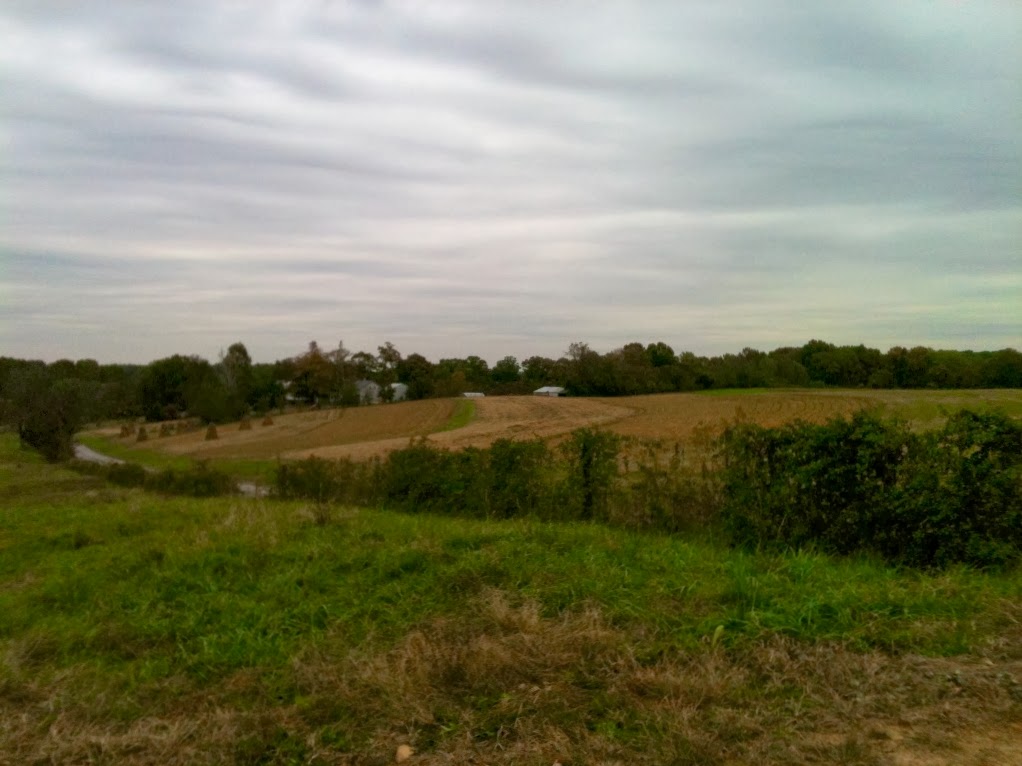
Kentucky is a beautiful state. I never appreciated this growing up, because (and I honestly have no idea where this came from) I had a deeply-seeded resentment of anything south of the Mason-Dixon line. Still, late fall, stress from school and eventual early adulthood brings with it dreams of hibernation, home and pie. Being able to  spend all day in pajamas is also high on my list these days. So after coming back to Memphis to visit my family for fall break, we took a road trip to Kentucky. The entire drive, I stared out the window, slightly out of breath over the forgotten beauty of so many rolling green hills. It seems I’ve developed some kind of armor to protect me from life in the northeast and, in the process, I have neglected to look up at the sky. Like Icarus, I flew too close to the sun. It takes coming home to realize you never needed wings in the first place.

I won’t pretend I’m a sophisticated northerner. I speak more slowly than many people I know; I don’t own any Ray-Bands or black high heels or know all the subway lines in Manhattan. Still, I’m noticing some stark differences between the vast, expansive south and the busy, densely populous northeast. For one, in the drive from Memphis to Kentucky, I saw more trees than people. More trees, more leaves on the trees, more blades of grass, more fish in the lakes, even more clouds in the sky. There is somehow more sky.

When the only thing you have to contest your existence against is something that’s existed for hundred of years, like a tree, you suddenly feel very, very small. It’s almost impossible  be existential in a city! There are too many people telling you you’re wonderful, and not enough reminding you that the trees were here first.

Also down south, people…are just so friendly. I always thought this was a myth, that people in the south are friendlier than in the north. “Just because people down south smile and wave and say ‘hello’ as if they mean it doesn’t make them more friendly.” Perhaps I will test this some time and see how long I can talk to a stranger in Memphis or Bowling-Green before he or she gets bored or scared of me. But at least when people greet me with a boisterous “hello,” I know they really mean it. You know that awkward semi-acknowledgement of a stranger’s presence, where you’re too shy and too busy to be genuinely interested in someone else’s day, but you don’t want that person to think a bad thought about you so you smile and eek out a timid “hi,” and the other person blurts out, “Hihow’sitgoin’?” and then just keeps walking? Yeah. In the south, strangers greet strangers with genuineness. And they separate their words.

Perhaps what I’m experiencing is a bit of rose colored glasses syndrome, that feeling you get when you’re in a new place, when you’re exhausted from what you’ve left behind, and you look at your present surroundings with admiration and bliss. To tell the truth, I never thought so rosily about the south when I lived there.

In fact, all I remember dreaming of (aside from other planets) was my fantasized, grown up life in New York City. So perhaps now as a young adult, I’ve begun to reverse the fantasy and trade skyscrapers for landscapes and subway lines for tractors. Or haystacks…

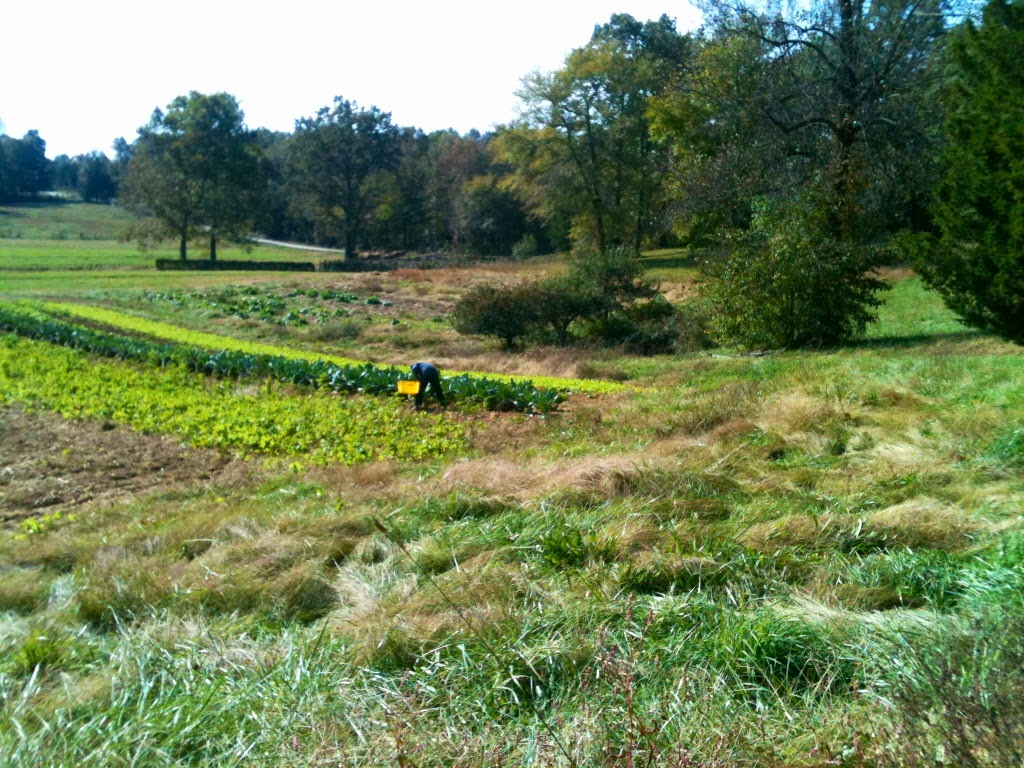
Our time in Kentucky was full of farms, animals, fresh air and Mennonites markets. I overheard the boy pictured at left (click to see the detail) speaking Dutch with his father, owner of the first Mennonite farm we visited, where my own father proceeded to buy over a hundred dollars worth of squash! Seriously.

I watched this boy, about ten, grab a basket and pluck a few leaves of kale from the stalk and then mosey on back up to his house, to sell it or to eat it.

I admit I was jealous. When I want to cook kale, I need a car, a shopper of the month card, cash, car keys, a wallet, and the patience to walk under halogen lights and stand in line at a conveyor belt while trying to ignore all the celebrity gossip and “HOW TO LOSE TWENTY POUNDS IN TWO DAYS!” advertisements.
.
Perhaps this trip was exactly what I needed. Blue skies and sunshine. Apple pie, baseball games, harmonicas and dogs on my lap. I had no idea I was so…American.

“Country rooooad, take me hoooome, to the place I beloooong!”


"There is an old Jewish folktale…"

“…about a man who went out into the world in search of true justice. Somewhere, he believed, a just society must exist, and he would not stop until he found it. His quest lasted many years and took him to many faraway places. He traveled from city to city, village to village, countryside to countryside, seeking justice like a lost treasure, until he had reached the end of the known world.

       There, at the edge of the known world, lay a vast, mysterious forest. Determined to continue his quest until justice was found, the man bravely crossed over into the shadows. He searched in the caves of thieves and the huts of witches, where the gruesome inhabitants laughed and scorned him, saying, ‘Do you really expect to find justice here?’


        Undeterred, the man wandered deeper and deeper into the woods, until at last he came upon a small cottage. Through the windows, he spied the warm flow of candles.

         Perhaps I will find justice here, he thought to himself. 
         
         He knocked on the door, but no one answered. He knocked again, but all was silent. Curious, he pushed open the door and stepped inside.

         The moment he entered the cottage, the man realized that it was enchanted, for it expanded in size to become much bigger on the inside than it appeared on the outside.  His eyes widened as he realized the cavernous expanse was filled with hundreds of shelves, holding thousands upon thousands of oil candles. Some of the candles sat in fine holders of marble and gold, while others sat in holders of clay or tin. Some were filled with oil so that the flames burned as brightly as the stars, while others had little oil left, and were beginning to grow dim.

          The man felt a hand on his shoulder.

          He turned to find an old man with a long, white beard, wearing a white robe, standing beside him.

         ‘שלום עליכם Shalom aleikhem, my son,’ the old man said. ‘Peace be upon you.’
  
         ‘עליכם שלום Aleikhem shalom,’ the startled traveler responded.

         ‘How can I help you?’ the old man asked.

          ‘I have traveled the world searching for justice,’ he said, ‘but never have I encountered a place like   this. Tell me, what are these candles for?’

           The old man replied, ‘Each of these candles is a person’s soul. As long as a person’s candle burns, he or she remains alive. But when a person’s candle burns out, the soul is taken away to leave this world.’


           ‘Can you show me the candle of my soul?’ the man asked.

            ‘Follow me,’ the old man replied, leading his guest through a labyrinth of rooms and shelves, passing row after row of candles.

         After what seemed like a long time, they reached a small shelf that held a candle in a holder of clay.

        ‘That is the candle of your soul,’ the old man said. 

         Immediately a wave of fear rushed over the traveler, for the wick of the candle was short and the oil nearly dry. Was his life almost over? Did he have but moments to live?

             He then noticed that the candle next to his had a long wick and a tin holder filled with oil. The flame burned brightly, like it could go on forever.

         ‘Whose candle is that?’ he asked.

          But the old man had disappeared.

          The traveler stood there trembling, terrified that his life might be cut short before he found justice. He heard a sputtering sound and saw smoke rising from a higher shelf, signaling the death of someone else somewhere in the world. He looked at his own diminishing candle and then back at the candle next to his, burning so steady and bright. The old man was nowhere to be seen.

        So the man picked up the brightly burning candle and lifted it above his own, ready to pour the oil from one holder to another.

         Suddenly he felt a strong grip on his arm.

        ‘Is this the kind of justice you are seeking?’ the old man asked.

        The traveler closed his eyes in pain and when he opened them, the cottage and the candles and the old man had all vanished. He stood in the dark forest alone. It is said that he could hear the trees whispering his fate.

         He had searched for justice in the great wide world but never within himself.”

Copied from A Year of Biblical Womanhood, pp 225-226, by Rachel Held Evans.

Photos taken in Prague at the Monastery woods and Old Jewish Cemetery, respectively. 

Not A Day Goes By That I Don’t Think of Be’er Sheva, Israel

        I read the news much more now than I did a year and three days ago, when I said farewell to John F Kennedy Airport and the Western Hemisphere and took off, unwittingly, to Asia: the Middle-East, to be technical, Israel, to be precise, Be’er Sheva, this random little desert city, to be exact. Despite the constant barrage of news reports about Israeli-United States relations, Israelis and Palestinians, Israel and the United Nations that I read daily, as I sit here cozily in my bed, on a lazy, rainy and very wet Sunday afternoon in lower Bucks County (deer country), Pennsylvania, I am so painfully reminded that this special little place that I called home is so, so, so very, incredibly far, far away.
To comfort myself, I look up and around my bedroom so as to feel connected to something. I begin to take inventory of my surroundings, and my eyes fall first upon the stack of books on my bed-side table. Books make me inexplicably happy. I love the shapes, sizes, and colors of books, from the very small and flimsy to the grandiose, heavy and sincere. Some I purchased abroad or at used book sales; some were gifts; some are on (very long) loan. I love the naked spines of my journals, which collect all my crazy thoughts, and the sparsely decorated historiographies and commentaries from Saints and sinners alike.
As my eyes feast on this variable cornucopia of information, I spy a small trinket, a pearl among the diamonds–a small, glass, hand painted bottle from Bratislava, which once contained a sample of Slovakian honey meade (travel size!). Now my eyes begin to wander, scanning past the sea of blue wall, to the double-pained window. A small assortment of jewelry, trinkets, and photographs rest there, along with an ill-crafted flute purchased in Bethlehem, on the off chance that I might have found some sheep that needed herding. Alas, I did not.
Below this sill sit my instruments: a large djembe perched on top of a foraged wooden stool and an old acoustic, three quarter size guitar. Suddenly, the term “traveling minstrel” begins to sound like a serious and viable occupation. But African drums are extremely cumbersome.
Above and to the right of the sill hang a few foraged and gifted pictures, not of people, but of wine bottles, sunflowers, inspirational quotes and a portion of Van Gough’s Starry Nights, repainted into a neat little four by four pun: “Van-Go,” and a Volkswagon beetle in the foreground.
My eyes turn again to the closet door, filled so deep with memories that I hesitate to unravel the fathoms just now. I think of the drawers of one cabinet, in particular; the bottom, being the deeper of the two, contains my old maps, travel guides, notebooks, ticket stubs, and Hebrew language learning assignments. Every map I gathered from every hostel I slept in or museum or mountain I visited I kept: from Eilat to Jerusalem to Budapest, Prague, Vienna, and Slovakia, and from Ein Gedi to Masada and Old Jaffa Hostel. Maps, like books, are precious jewels to me, founts of invaluable and unique information. On them I marked and circled all the sites I loved, the restaurants that served good beer or dessert, the hostels with the friendliest staff, the nearest bus terminal and number.
I am there now, at the bus terminal in Bratislava, sipping a Pilsner inside the station pub, which itself was converted from an out-of-use street car. Then I jump to the porch outside the Ein Gedi hostel, perched with free café (instant, in that red and black packet, and milk from a pouch!), watching the full moon rise over the Dead Sea, Jordan in the background. (As close as I was and as many times as I saw the cities and mountains of Jordan, I never actually crossed the border, despite Petra being a huge tourist destination. I have to go back!!) In my mind I wake up and stretch to greet the great dense, salty sea, then climb, high, higher still up the mountain to the highest legally allowed point in forty degree centigrade heat, then down, deep down into Dodom’s cave and waterfall. Oh, the magic of the desert!!!
My heart longs again for those secret places in the land, those deep mysteries that are so fixed, ancient and overwhelming. I come back to my room, and my eyes fall upon my favorite poem, framed and mounted above my chest of drawers, and I begin to read:

Go placidly amid the noise and the haste, and remember what peace there may be in silence.

     I think again of the silent and the chaotic in far away lands. I think of the silent and chaotic demons that test us here in my home country, indeed in my very heart and soul. Tests, challenges, other points of view–as cliche as it sounds, I found myself through living day in day out in Be’er Sheva, getting to sleep each night and waking up with the hot desert sun on my face. I found something I had been looking for since I was a little girl: the confidence and serenity to feel my feet fixed firmly on the ground, yet the faith to throw caution to the wind and let these same feet fly out from under me, over a rock into water or down into a cave. I found the truth–that the world is not such a nice place all the time, and that your life will never be what you want it to be if you put your store in changing times that make headlines, sell newspapers, and send people time and again to war. I think this is why so many pilgrims come to Jerusalem, why so many religious faithful live in Jerusalem, and why that city is and has been and will probably always be the hottest place on Earth:  they know, they understand that the ebbing tide of change only rushes over what is firmly rooted into time and space: God and his plan for us.
I have no answers for peace in the world, but I will forever strive, and may we all work for this:

     In the noisy confusion of life, keep peace in your soul.