If you’ve ever thought that spending time in nature sounded nice, have you checked out WWOOF?
WWOOF stands for World Wide Opportunities on Organic Farms, and is exactly what the name says. It is an international network of organic farmers, who serve as hosts for eager travelers. It’s a chance to explore a different region/country/continent, practice some language, learn a skill, and develop amazing relationships you’d never expect.
I spent the last two weeks of my spring Eurotrip WWOOFing (yes, it’s a verb) in Basse-Normandy, France.
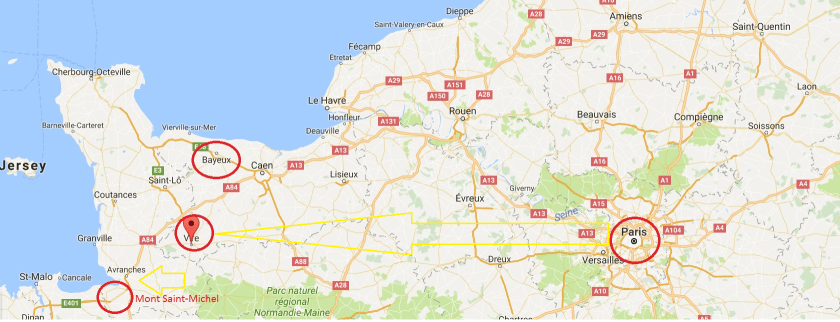
A map of my route, for reference!
How did I choose a tiny town in Basse-Normandie? Simple. On the WWOOF website (you pay 20 Euro be a member for a year and then you have access to the catalogue of host farms in the country you choose) there is a list of filters including type of activity (IE permaculture, orchard, dairy, eco projects) and length of stay (one week, two weeks, 1 month). I had two weeks to farm; I was interested in orchards and eco projects. So I found La Fermette du Bellefontaine.
A rainy day on La Fermette
La fermette means “little farm,” and that’s exactly what it was: a small scale organic farm owned and operated by a few friends. Each had his and her own plot of land and primary source of income: one is a vegetable gardener, one a seamstress, and my host, the master baker.
For most French people, bread is life. It’s fresh, it’s inexpensive and it’s eaten three times a day. And why wouldn’t you eat it when the grain was grown and harvested three miles away?
As for eco projects, these included a composting toilet (of which I sadly did not take a picture, but I’ll leave that to you to research), an organic sewage system that uses water-loving plants to clean used water, and newspaper insulation. All created by my host out of his desire to “be as autonomous as possible.”
It’s amazing what you can learn when you least expect it, when you enter into a new situation with zero expectations. I left a lot more informed about steps I can take as an individual to reduce my impact and respect our planet. And I had the best cheese of my life.
View of the town from a hilltop! Not pictured: the medieval fortress I climbed to take this photo.
“A prophet he was, without words, but with a most beautiful personality. A prophet he was, without words; A prophet–with righteousness and mercy.”
-The Prologue from Ohrid, St. Nikolai Velimirovic (1880/1-1956)
Almost every night at dinner when I was little, my dad would open The Prologue from Ohrid and read a passage on the life of a great saint. This life story usually ended with a gruesome martyrdom (being torn apart by lions in a Roman amphitheater, for example), followed by a prayer invoking the intercessions of the saint (oh holy Saint n., pray to God for me). There are a lot of oddities like this encompassed in early Christian tradition…
It was odd growing up Orthodox in America; I never knew how to explain to people that I was Orthodox, but not Greek or Russian and often felt insecure about being the odd one out at parties. In all my travels up until now, I realized that I had never once been to an Orthodox country.
That changed last month when I went to Macedonia for the first time. Macedonia, if you’re wondering, is a tiny country situated in between Greece, Bulgaria, Serbia, Kosovo (another contested state), and Albania. The country is also referred to as FYROM–the Former Yugoslav Republic of Macedonia–because it is just that. Its national sovereignty is also contested by Greece.
Regardless of Macedonia’s current political status, the country is mostly Orthodox (the second largest religious group being Muslim, I believe). Most people there speak Macedonian (a Slavic language very closely related to Bulgarian), while others speak Albanian (and technically refer to themselves as Albanian, not Macedonian). There is also a Roma population who speaks Romani and something else, I forget what. And that is, unfortunately, the extend of my ethnographical knowledge. Still, the country takes all Eastern Orthodox religious holidays as national holidays, including Good Friday and Bright Monday (the day after Easter/Pascha). So, with my friend whom I was visiting, we went to Ohrid, a lake town about three hours southwest of the capital city, Skopje.
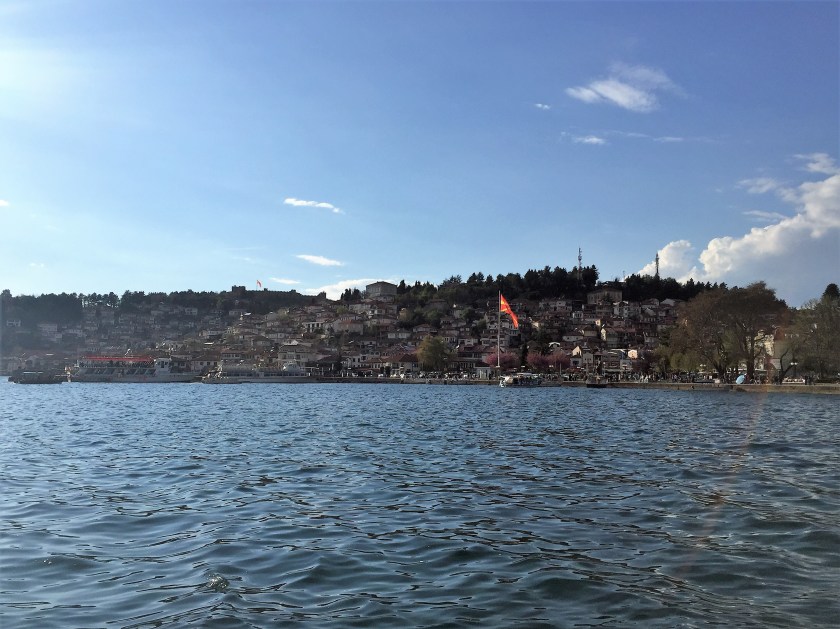
Ohrid reminded me a tiny bit of Jerusalem: textile and sweet shops lined narrow, cobblestone streets as mobs of families and tourists forced their way through. But then, once you turn a few corners, you come to Lake Ohrid and find a beautifully pristine scene reminiscent of southern Italy with its sunny sidewalk cafes:
A view of old Ohrid from the pier
Indeed, the weather was beautiful, a far cry from the wintry storms I had experienced up until then (and would experience again after leaving Ohrid :(). We took advantage of the sunshine to explore the city’s tiny cobblestone roads. This was how I began to understand its ancient history and the connection to early Christianity.
Ohrid is a city on a hill, with the homes, corner stores, and churches built into the landscape. The further we climbed, the more I began to realize that there was a church on virtually every street corner; sometimes two or three. Not all were very large or even open. But there they sat, sometimes tucked in between homes, always with a sign of patronage (the church of St. Barbara, St. Sophia, Sts. Constantine and Helen, for example). Once we reached the top of the hill, I laid eyes on another ancient site that began to make my brain spin: a half-uncovered Roman amphitheater.
Roman amphitheater
Remarkable as this structure is, it is to be noted that quite possibly, this amphitheater was used to execute Christians in the Roman period before Emperor Constantine legalized and embraced Christianity and shifted the capital east to Constantinople (now Istanbul). After learning this fact, I started to wonder if that’s why Ohrid has so many churches, and why the Prologue (the compilation of martyrs stories I mentioned earlier) was penned from this ancient city.
One can only postulate.
Having this in my mind, I felt very cautious the rest of the weekend. Upon whose bones might I have unknowingly tread? It began to feel even more like Jerusalem, a place where every stone and grain of sand has history.
Yet here I was on Easter weekend, the time when Christians celebrate Christ’s victory over death and the promise of a life that transcends earth. My mind couldn’t understand it. But somewhere deep down, my heart knew something was amiss on the eve of Pascha. I felt afraid and timid as I ventured out of my AirBnb around 10 pm, alone, in the dark, trying to find the Church of Sts. Clement and Panteleimon, where I knew many Macedonians would be gathering. I said a prayer as I walked uphill toward the ancient fortress (another pre-Christian era force of strength built by relatives of Alexander the Conqueror) and it must have been heard, because as soon as I started strolling down a very dark, remote path, someone called to me from a house across the way “not that way!” Through a brief exchange of gestures, I eventually figured out the proper direction. Once I hit the street I was swept up in a loose crowd of people all walking the same direction. Men sat on the side of the street selling candles. I figured I was in the right place. I arrived to the ancient church, which overlooks the lake from high atop the hill. Already families were gathered outside.
Close-up of the iconic Church built by St. Clement, who is buried inside.
Families gathering outside the Church
I went inside, venerated the icons (a traditional greeting and sign of respect when one enters an Orthodox church) and then stood against a wall, waiting. I was greatly pleased at how normal everything felt. I have always loved this about the Orthodox church. No matter where in the world one may be, the church has the exact same meaning.
Eventually the service began with the traditional invocation. Even though most of the prayers were in Macedonian, I knew essentially what was happening, because again, the services follow the same pattern the world over. About fifteen minutes in to the night, all the lights went out. This signifies the night. Then the priests (there were two, as well as the Bishop present) began to sing…in English, the words are this: Come take light from the Light that is never overtaken by the Night. Come glorify the Christ, Risen from the dead. I can’t tell you what the Macedonian is, but I know its meaning. Which is pretty cool, I think. As they sing, they pass by with candles and share a flame, until every person present has a lighted candle. Then they left the church and we followed out, until we were mostly outside.
At this point, may more prayers were said and the Gospel was read to the crowd. Then the Bishop began to speak. Though I could not understand, I did hear Makedonia mentioned several times in the speech. It was then that I had another thought about the connection between Church and State and how, in some ways, I wondered how differently the Church was perceived in Macedonia. Is it seen as an institution, as most churches are perceived in the States? I’m sure to some extent, yes, though I shouldn’t make assumptions. But it was a great reminder of the limitations of man’s own agenda in the political makeup of history and one of my favorite lines from the Orthodox liturgy (from a Psalm of David):
Put not your trust in princes, in sons of men, in whom there is no salvation.
Then the bells began to ring, and a familiar song came through the air:
I apologize for the poor video quality, but the song is this:
Christ is Risen from the dead
trampling down death by death
And upon those in the tombs bestowing life!
The smells of incense and candle smoke perfumed the air as I walked home later on in the early morning hours. I looked over hill top and the moon was smiling at me from above the clouds, illuminating other churches and homes where I knew the same prayers were being said and the same Resurrection was being celebrated. It was as if the night was saying to me, “Why are you afraid? There is Peace. There is Light. And you are wonderfully small.”
Charm, family, history, and agency. These words summarize my quick but memorable trip to Goslar, Braunschweig (aka Brunswick) and Berlin, Germany.
Berlin was my first stop in Europe; normally I arrive exhausted from a long trip and wander around the airport until I find a person or a sign to direct me to where I am going. But this time, my cousin and sister were waiting for me. I’m so used to going this alone that it was definitely a nice change, and I was so glad to explore Germany with them. My cousin and her boyfriend live in Brunswick, about two and a half hours west of Berlin. I ended up staying with them longer than expected because of some travel miscommunications, but this was fortunate as we got to explore a former medieval mining town and UNESCO heritage sight, Goslar. Below are a few photo highlights:
That’s Goslar in the background. Behind us were thick, piney woods, and above us were some daring paragliders. All in a half a day’s visit 🙂
Hummus victory!
After leaving Brunswick, I went back to Berlin to meet up with a friend and former study-abroad companion. It has been four years since studying abroad and seeing her, but it felt like no time had passed. And it was so nice to talk about life and politics and how much our lives continue to be shaped by those momentous, sandy six months in 2012. She even found a delicious Israeli hummus restaurant like the ones we used to eat at in Be’er Sheva. Here’s the secret: don’t add too much tahini and serve the hummus warm.
I suppose no trip to Berlin would be complete without visiting some historic sites, including the Berlin Wall Memorial, which stands soberly as a poignant reminder of the futility of walls and the resiliency of the human spirit; the East Side Gallery, another remaining portion of the Wall that has been covered with beautiful and provocative murals from artists all around the world; and the Topography of Terror, a museum that covers the Nazi atrocities from historical and sociopolitical perspectives, on the sight of the former Reich Security Main Office, aka the Nazi and Gestapo headquarters.
This slideshow requires JavaScript.
You will never run out of things to do or ways to get there in Berlin. I was amazed at how quickly I felt at home on the S-Bahn, even when I took the wrong train.
My friend and I talked about the politics of asylum in Germany and how quickly those policies are changing throughout Europe and the USA. It was very sobering; it seems the whole world is trying to come to Germany, while half a century ago, millions were trying to leave, and no one seems prepared for how rapidly the world is changing these days. Memorials and museums are supposed to teach us how we let these things happen and challenge to ask ourselves, “Why?” It’s so easy to remain quiet and complacent out of fear or willful ignorance, and I’m certainly guilty of that. But I listened to an American podcast last night about the US elections, and I was reminded of how empowering protesting or civil resistance can be in the face of oppression. Like the man in the picture above, I don’t have to raise my hand just because everyone else does.
I hope you’ll go to Berlin someday, if you haven’t already. I hope Germany will still be an open and welcoming place when you go. Berlin is…funky.
I fell in love with Prague five years ago on my first trip to Europe. The moment I stepped on to the Charles Bridge, I felt home. I also contemplated moving there and supporting myself by singing opera on the famous bridge for money. I even wrote a set list. But while my chanson dreams might be on hold for the time being, I was overjoyed to find Prague’s charm and romance no less palpable on my second visit, and I have a feeling I will never stop returning to Prague.
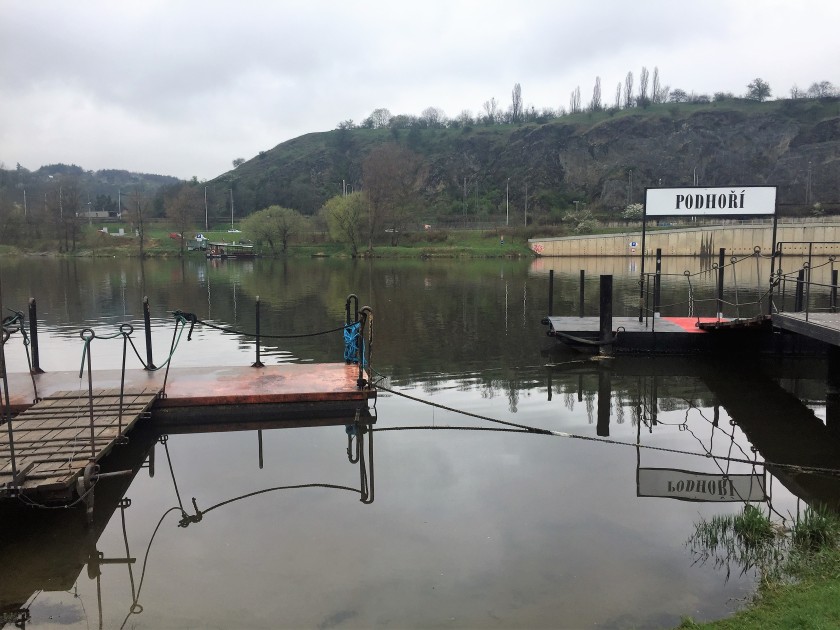
On the outskirts of Prague, waiting for our boat taxi to take us across the Vlatlava…
Prague has an ancient history, and some of its oldest standing buildings date back to the 14th century, when King Charles IV, ruler of Bohemia and later the Holy Roman Empire (which included all of Germany, Switzerland, Belgium and the Netherlands, most of the Czech Republic and parts of Austria, Poland, Italy, and France) established the first university in Prague (King Charles University). It’s no big deal to walk around a neighborhood in downtown and see modern trams running next to gothic cathedrals and art-noveau buildings. This is the flavor of Bohemia!
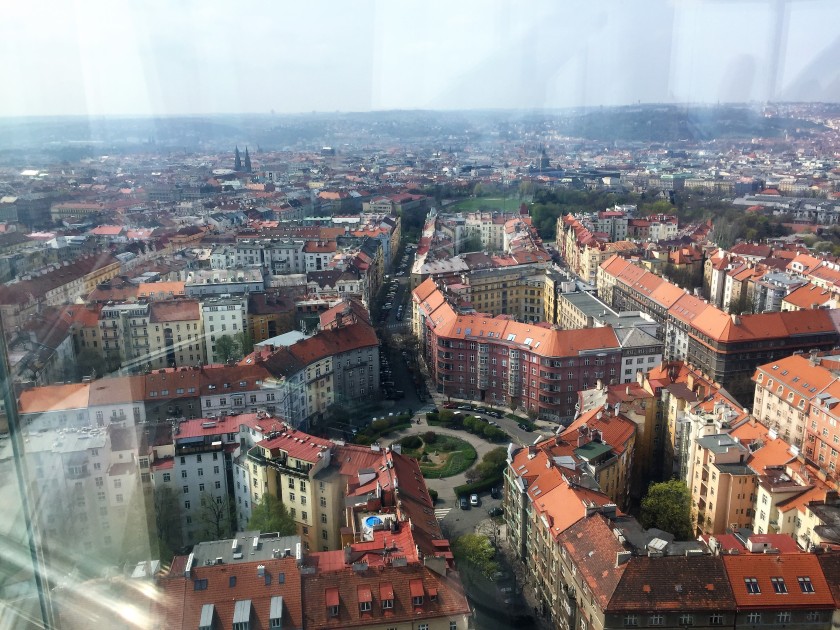
Of course, there are also a few modern additions, including the infamous TV tower, notoriously hated by Czech people, which was built under communism. The building might be an eyesore, but it offers some of the best views of the city. We rode to the top of the tower and had a 360 degree view of all of Prague’s architectural wonders:
View of Zizkov neighborhood from the Prague TV tower. The slanted, red brick roof are a signature style of the city; in the distance you can see Gothic spires peeking up to say hello!
In Old Town Square (Staroměstské náměstí), one can find the famous astrological clock (which parades a collection of dancing marionettes every hour on the hour…think “world’s biggest coo-coo clock”), as well as several churches, a memorial to Jan Hus (Protestant reformer), and this hidden gem inside the old City Hall, the Skautsky Institut (Scout Institute, non-profit and community organization for youth. If you’re there, you should visit their café inside the building on the second floor. It reminded me of several funky coffee shops in Memphis, only a bit smaller.
A side view of the very old City Hall building, which is now owned by the city and rented out to the Skautsky Institut and other organizations.
No trip to Prague would be complete without a visit to the famous Prague castle, which is a huge compound that includes the Gothic St. Vitus Cathedral, beautiful Baroque-style gardens, and several ancient halls where kings of old were crowned and celebrated and some unpopular nobles were pushed out of windows. The castle stands on a hill top, and its spires are visible for miles. The area also offers some of the most picturesque views of the city, like the ones below. On the left is from this trip (our weather was less than ideal, but c’est la vie). On the right is from five years ago. There’s a bit more sunshine and fewer trees, but it’s still the same skyline!
a view of Prague’s skyline last week
a view of Prague’s skyline on my first trip, five years ago
When you visit the Castle, I highly recommend a guide and a comprehensive admissions ticket. I didn’t do this last time, but I am so glad I did on this trip. It is a bit pricey for Prague ($14 USD), but the ticket gets you inside of the Cathedral, the old hall, All Saints Church, and the Golden Lane, which is a small, cobblestone street with museums and displays about Prague in the High Medieval era. All in all, you get an a lot of insight into Prauge’s complex history. Bonus: It also includes a visit to the dungeon and a few dozen rusty torture instruments on display (Game of Thrones, anyone?).
The interior of St. Vitus Cathedral
an example of the stained glass inside the cathedral
benches for worshipping; in the background stands the tomb of one of many Medieval kings burried here
the southern exterior of the Cathedral
The second visit was even better than the first. This was largely due to the gracious hospitality of our friend, host, and tour guide, whom I had met five years ago while studying in Israel. She took us to some truly remarkable places that were tucked away inside cobblestone lanes, including a hip vegetarian restaurant called Lehka Hlava (which means “Clear Head” and runs only on reservations) and a wonderful little wine bar dedicated to St. Agneska (Agnes), who founded a small monastery nearby in the 13th century, before Gothic spires had taken over Europe. We all decided that this place, called simply Agnes, serves the best hot wine in Prague. The key is to add raisins soaked in rum, and serve it with a spoon for fishing out these delicacies.
I heard from my friend that the owners of this wine bar are ready to retire. They want someone to take over and continue serving wine and snacks to locals for the next few decades. My friend is too busy, but who knows? Maybe I can work there when people get tired of hearing my rendition of Ave Maria on the Charles Bridge…






 Another Adventure